Gallium (Ga) and germanium (Ge) will be subject to export controls starting August 1, 2023 “to protect national security and interests,” China’s Ministry of Commerce said in a statement. Exporters of these raw materials will need to apply for "special permission from the state" to ship them out the country, China's Ministry of Commerce and its General Administration of Customs (GAC) said July 3 in a joint statement. China is a major supplier of both the world., accounting for 94% of the Ga market supply and 83% of the Ge market supply, according to the customs data. So what exactly are these two metals used for in semiconductor production? How will this export restriction affect global semiconductor manufacturers?
Two Rare Earth Minerals
Gallium
1. Basic Information
Gallium is one of the strategic minerals in the world. It is a gray-blue or silver-white metal with atomic number 31, element symbol Ga, and atomic weight 69.723. Ga has a low melting point but a high boiling point. Pure liquid gallium is easily oxidized in air to form an oxide film.
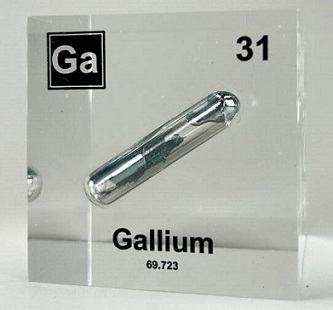
The atomic structure of Ga includes 31 protons and electrons, and a corresponding number of neutrons. In chemical reactions, gallium atoms usually exist in a trivalent state, that is, they lose three electrons to form Ga3+ ions.
It is a kind of scattered metal with low melting point and high boiling point, and has the characteristics of high electrical conductivity, medium thermal conductivity and low toxicity in liquid state, which is a promising raw material for the synthesis of intelligent functional materials. Also it has good electrical conductivity and can be easily combines with many other metals to form low melting point alloys.
2. Industrial Use
1) Produce gallium nitride, gallium arsenide, gallium phosphide, germanium semiconductor doping element.
2) Pure gallium and low melting alloy can be used as heat exchange medium for nuclear reaction.
3) As filling material for high temperature thermometer.
4) As catalyst for diesterization in organic reaction.
Ga's applications are primitive, although its unique properties may expand more fields. Liquid gallium's wide temperature range and its low vapor pressure make it useful in pyrometers. Gallium compounds, especially gallium arsenide, have attracted more and more attention in the electronics industry. In addition, precise gallium production data in the earth are not available, but production in neighboring regions is only 20 tons/year behind China.
3. Fields of Use
1) Gallium plays an important role in the semiconductor industry. It is used in the manufacture of high-speed electronic devices, optoelectronic devices and solar cells. For example, Gallium-based semiconductor materials, such as gallium arsenide (GaAs) and gallium nitride (GaN), have excellent electrical properties and high-temperature characteristics, and are suitable for the high-frequency and high-power electronic devices.
2) Gallium compounds are widely used in the manufacture of LED lights. Ga-based LEDs have the advantages of high efficiency, long service life, and energy saving, and are widely used in indoor and outdoor lighting, electronic displays, and automotive lighting.
3) Gallium can be alloyed with other metals to enhance their properties and performance. For example, gallium alloys are used to prepare low-melting alloys such as gallium-indium alloys (often used in thermometers) and gallium-bismuth alloys (often used in fire alarm devices).
Germanium
1. Basic Information
Germanium is a chemical element with symbol Ge, atomic number 32, and atomic weight 72.64. It is located in the fourth period and group IVA of the periodic table of chemical elements. And Germanium, Tin and Lead belong to the same group in the periodic table of elements.
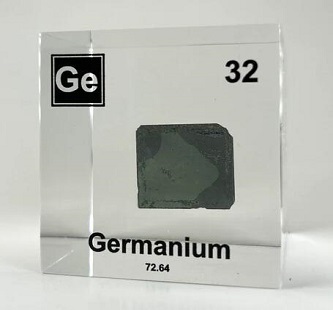
Ge element is a gray-white, shiny, and hard metal, belonging to the carbon group, its chemical properties similar to tin and silicon of the same group, insoluble in water, hydrochloric acid, dilute caustic solution, and soluble in aqua regia, concentrated nitric acid or sulfuric acid. Ge is amphoteric, so it is soluble in molten alkali, alkali peroxide, alkali metal nitrate or carbonate, and is relatively stable in the air.
Ge atomic structure includes 32 protons and electrons, and a corresponding number of neutrons. In chemical reactions, its atoms usually exist in a tetravalent state, that is, they share or lose four electrons to form Ge4+ ions.
It is one of the most scattered elements in the earth's crust, and has been listed as an important strategic resource for strategic reserves by many countries. It has the properties of being pro-lithic, pro-iron, pro-sulfur, and pro-organic, and has sound properties and excellent mechanical properties of high infrared refractive index and low dispersion rate.
The main sources of its raw materials are: lignite-germanium ore, lead-zinc smelting by-products, Ge ingots and single crystal waste. At present, 26 kinds of germanium-containing minerals have been discovered, among which ash germanite and germanite are the most common, followed by sulfur germanium iron copper ore and sulfur silver germanium ore.
2. Industrial Use
Ge is an important strategic resource, and has special properties in many aspects, and has extensive and important applications in semiconductors, aerospace measurement and control, nuclear physics detection, optical fiber communication, infrared optics, solar cells, chemical catalysts, biomedicine and other fields. What’s more, in the electronics industry, it can also be used as a catalyst for alloy pretreatment and optical industry.
High-purity Ge can be obtained by reducing high-purity germanium oxide and then extracting it by smelting.
Single crystal germanium doped with a small amount of specific impurities can be used to make various transistors, rectifiers and other devices.
Germanium compounds are used in the manufacture of fluorescent panels and various high refractive index glasses.
Germanium single crystal can be used as transistor, which is the first generation of transistor material.
It is used in radiation detectors and thermoelectric materials. High-purity Ge single crystal has a high refractive index, is transparent to infrared rays, and does not pass through visible light and ultraviolet rays. It can be used as a germanium window, prism or lens for infrared light.
At the beginning of the 20th century, germanium was used to treat anemia, and then became the earliest semiconductor element used. The refractive index of elemental germanium is very high, and it is only transparent to infrared light, but opaque to visible light and ultraviolet light. Therefore, military observers such as infrared night vision devices use pure germanium to make lenses.
Compounds of germanium and niobium are superconducting materials.
Germanium dioxide is a catalyst for the polymerization reaction. The glass containing it has high refractive index and dispersion performance, and can be used as a wide-angle camera and microscope lens.
Germanium trichloride is also a new type of optical fiber material additive. In the early 21st century, the recovery of the global optical fiber network market, especially the optical fiber market in North America and Japan, drove the rapid growth of the optical fiber market. The annual growth rate of global optical fiber demand has exceeded 20%.
According to the data, since 2013, the development of the optical fiber communication industry, the continuous expansion of the application of infrared optics in the military and civilian fields, the use of solar cells in space, and the promotion of ground-based high-efficiency solar power plants have made more demand for germanium.
3. Fields of Use
1) Ge is an important material in the semiconductor industry. It is used in the manufacture of high-speed electronic devices and optoelectronic devices, such as high-purity germanium wafers for the manufacture of solar cells and infrared detectors.
2) Ge optical fiber plays an important role in optical fiber communication. It has a high refractive index and transparency, and can be used to manufacture optical fibers and optical fiber amplifiers in high-speed communications.
3) Due to the transparency of germanium to infrared radiation, it is widely used in infrared optical systems and infrared imaging technology. Ge- lenses and -windows are used in areas such as infrared sensors, thermal imagers and infrared laser systems.
4) Ge compounds are often used as catalysts and have important applications in the chemical industry, which can promote chemical reactions and are used to produce polymers, prepare organic compounds, and more.
Gallium and germanium, as rare metal elements, play an important role in high-tech fields, electronics industry, energy industry, etc.
Other Points
China Controls Most of the Rare Earth Metals
Whether in terms of reserves or exports, China occupies a leading position in the world of gallium and germanium.
According to the data released by the United States Geological Survey (USGS), the current global reserves of gallium metal are about 279,300 tons, while China has the largest reserves of 190,000 tons, accounting for about 68% of the global reserves.
Germany and Kazakhstan stopped gallium production in 2016 and 2013 respectively. In 2021, Germany announced that it will restart primary gallium production. Hungary and Ukraine stopped gallium production in 2015 and 2019 respectively. So China’s gallium share in global gallium production continues to increase. By 2021, its share of global gallium production has exceeded 90%.
According to USGS data, China accounts for 41% of global germanium resources, and the United States accounts for 45%. In 2021, the global production of primary germanium will be about 130 tons, of which China and Russia account for 70% in the world. What’s more, China is the world's largest germanium producer, accounting for 68%. In the past ten years, it has supplied 68.5% of the world's germanium.
China is the world's largest germanium resource reserve and consumer. After years of development, the layout of the germanium industry chain has gradually improved. Germanium processing enterprises are mainly concentrated in deep processing links such as germanium dioxide, germanium tetrachloride, and zone-melted germanium ingots.
At the same time, China is one of the important exporters of germanium oxide in the world. From the distribution of export regions, the main export destinations of China’s germanium oxide are Japan, France, Spain, Germany, South Korea, Italy, the United States and other places.
What is the Impact of China's Restrictions?
Analysts pointed out that China may strictly control the production and export volume of gallium and germanium, and the trade structure of the global gallium and germanium market may will have different effects. At the same time, China's export quotas for gallium and germanium may be reduced, and the possibility of rising prices of related products cannot be avoided. For example, the prices of GaAs substrates and raw materials have risen or there is a shortage of supply, which will increase the pressure on manufacturers.
In addition, metals industry analysts CRU Group added that seeking alternatives could cost more and could hinder the development of technical performance.
Can Other Countries Produce More?
Neither metal is particularly rare, but processing can be expensive and pollute the environment. In one hand, China has exported both with a relatively low price, so there are few extraction facilities elsewhere. In the other hand, other counties have cut production even discontinued. If there is a market, other suppliers will ramp up production to meet demand if China's move causes prices to spike.
Of course recycling is also possible. For example, factory scrap already accounts for some of the supply, while germanium scrap is also recovered from the windows of decommissioned tanks and other military vehicles, according to the U.S. Geological Survey. Besides China, other countries with gallium production capacity include Russia, Ukraine, South Korea, Japan, United States and Belgium.
In addition, relevant industry analysts said that as the United States and its allies continue to escalate the microchip trade war and technology suppression, it is normal for China to take some measures to safeguard its technological development and national security.

 English