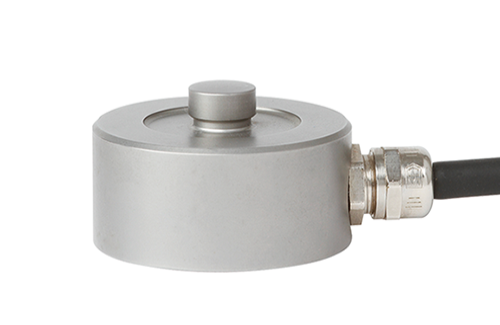
A Force Sensor is characterized as a device that transforms various mechanical inputs such as loads, weights, tensions, compressions, or pressures into an electrical signal, often referred to as a load cell, specifically, an electrical output signal that is quantifiable, convertible, and standardized. As the magnitude of the force exerted on the sensor rises, the corresponding electrical signal adjusts proportionately. Additionally, Force Sensors are frequently termed as Force Transducers. Various load cells exist, differentiated by their size, shape, and capacity.
Types of Force Sensors
Broadly speaking, there are four distinct force sensor technologies categorized by the behavior of their sensing elements. These methods encompass capacitive, inductive, piezoelectric, and piezoresistive elements, each capable of operating effectively across diverse environmental conditions.
Inductive Force Sensor
An inductive sensor operates based on the principle of electromagnetic induction to detect or measure objects. When there's a change in the magnetic field passing through the inductor, a current flows through the circuit, contrasting with situations where an inductor carrying current generates a magnetic field.
This mechanism detects metal objects due to their interaction with the magnetic field. The advantage of an inductive sensor lies in its capability to operate in wet or dirty conditions since substances like liquids or certain types of contaminants don't affect its magnetic field. Some inductive sensors adapt their properties for force measurements, including self-inductance, mutual inductance, and generating eddy currents.
Inductive force sensors are particularly effective for capturing low force readings and displacement metrics. The advent of bi-directional inductive force sensors enabled the measurement of force magnitude and orientation within a specific plane. With the application of an AC magnetic field from the LC sensor, eddy currents arise on the conductor's surface. These eddy currents create an opposing magnetic field, effectively diminishing the inductance of the sensor, leading to variations in inductance relative to distance.
High frequency Oscillation
The oscillator produces a high-frequency electromagnetic field that emanates from the sensing surface of the switch. When conductive metal interacts with this electromagnetic field, it induces eddy currents, altering the amplitude of the oscillations. Consequently, there's a voltage shift at the output of the oscillator, leading to changes in both the trigger's status and the overall output state.
Magnetic Inductive Sensor
Magnetic sensors are activated by the presence of a permanent magnet. Their operational principle is based on reed contacts, consisting of slender plates sealed within a glass bulb filled with inert gas. When exposed to a magnetic field, these plates flex and make contact with each other, establishing an electrical connection. The plates are coated with a material well-suited for applications requiring low current or for circuits with high inductive loads.
Magnetic sensors offer advantages over traditional mechanical switches. The hermetically sealed glass bulb, combined with the inert gas, provides robust protection against dust, oxidation, and corrosion. Instead of relying on mechanical components, these sensors operate through magnetic fields. Additionally, the specialized treatment applied to the contacts ensures an extended operational lifespan.
Capacitive Force Sensor
Capacitive sensing utilizes electrical capacitance measurements between conductive elements within a dielectric setting. These sensors evaluate properties of materials, including their dielectric constants. The technology is particularly effective with integrated circuits, facilitating the creation of compact sensor designs. Capacitive sensors find applications in various areas such as measuring pressure, distance, thickness, proximity, and detecting touch.
Analog Capacitive Sensor
The analog capacitive sensor operates similarly to standard capacitive sensors but provides distinct advantages depending on its application. When juxtaposed with conventional capacitive proximity sensors, analog capacitive sensors showcase multiple benefits. They excel in diverse scenarios, encompassing material choice, monitoring product thickness, tracking concentration changes, and detecting proximity.
Miniature Capacitive Sensor
The design of such capacitive sensors enables them to snugly fit into very compact areas. Operating akin to task-counting detectors, they are predominantly employed for overseeing and controlling machine operations. To ensure optimal accuracy in confined spaces, these compact sensor heads necessitate an accompanying amplifier. Consequently, the external amplifier features a potentiometer, enabling adjustments to sensitivity levels as needed.
High Temperature Capacitive Sensor
In situations where the sensor head is exposed to a broad spectrum of temperatures, high-temperature capacitive sensors come into play. These sensors exhibit the capability to reliably detect liquid temperatures and bulk materials even under challenging conditions, maintaining their effectiveness even when in direct contact with elevated temperatures and hot substances.
Piezoelectric Force Sensor
An example of a piezoelectric force sensor is a device that leverages the piezoelectric effect. When certain materials experience mechanical stress or forces along particular axes, they generate an electric voltage.
Piezoresistive Force Sensor
Resistive force sensors adjust their resistance levels and generate the required output while monitoring diverse environmental conditions such as force, strain, and pressure. These sensors employ a force-sensitive material, which can either be directly integrated onto the sensor or attached to it, typically known as a strain gauge. When an external force acts on the sensor, the resistive element deforms against its substrate. This deformation causes the conductive material on the substrate to make contact with the active region, particularly when air moves from the spacer aperture through the tail's air vent. This contact enables conduction, leading to a decrease in the material's resistance.
Within industrial sectors, force transducers play a crucial role, especially for tasks like weight measurement and production monitoring. The emphasis on force measurement is paramount, particularly in gauging forces in industrial machinery and systems like presses, assembly lines, and end-of-line inspections, necessitating the use of force transducers.
Given the demand for force measurements across various sectors such as instrumentation, robotics, medicine, artificial intelligence, vehicles, and wireless communication, among others, researchers have shown significant interest in force sensing technology. Moreover, force sensing presents challenges due to the diverse scales of measured forces and external influences like noise, environmental factors, and material properties. This research comprehensively explored various force sensing technologies, optimization strategies, and evaluated the application of force sensors across a range of fields.
KUKE insists on supplying only original electronic components, such as high quality load cell force sensor. If you have any question, please contact KUKE immediately.

 English