Resettable fuse or PTC fuse is a common overcurrent protection device used to protect circuits from faults such as overcurrent and short circuits. It uses the special properties of materials to quickly disconnect the circuit and prevent the flow of current when faults occur. Once the problem is solved, the resettable fuse can automatically restore the conductive state, allowing current to pass through again.
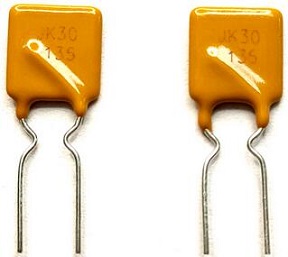
Resettable Fuse Basic
Working Principle
Resettable fuses consist of a heat-sensitive material (usually a polymer) and two electrodes. That is, it is made of high-molecular organic polymers mixed with conductive particle materials under the conditions of high pressure, high temperature, and vulcanization reaction, and then processed through a special step. Under normal circumstances, the resettable fuse is in a conducting state and current can pass smoothly. However, when an abnormal current passes through the resettable fuse, the heat generated causes the high molecular organic polymer to expand, and the conductive particles wrapped in the high molecular organic polymer will separate, thereby cutting off the conductive channel of the PTC, causing the PTC resistance to increase and reducing the abnormal overcurrent. When the problem is solved, the high molecular organic polymer of PTC shrinks to its original shape and reconnects the conductive particles, the conductive channel is restored, and the PTC resistance returns to its original low resistance state. At this time, the resettable fuse will reconnect the circuit. This move greatly saves time and improves safety.
Main Parameters
(1) Maximum voltage (Vmax): It refers to the maximum voltage that the resettable fuse can withstand. If the voltage exceeds this value, the thermistor inside the fuse may be broken down, then the fuse will lose its self-restoring function.
(2) Maximum current (Imax): It refers to the maximum current that the resettable fuse can withstand. If the current exceeds this value, the thermistor inside the fuse may be broken down.
(3) Holding current (IH): It refers to the maximum operating current at an ambient temperature of 25°C. When the current is less than this value, under ideal conditions, the PTC can maintain normal operation for an infinite time. At this time, the PTC will not change from a low-resistance state to a high-resistance state.
(4) Trip current (IT): It refers to the minimum current for the self-restoring fuse to start protection at an ambient temperature of 25°C. When the current exceeds this value, the PTC changes from a low resistance to a high resistance state (when a large current passes through, the component generates a large amount of heat that cannot be dissipated, causing the internal temperature to rise, causing the polymer material to expand, blocking the conductive path, and the resistance value rises rapidly, limiting the large current pass through).
Note: When the current is between the holding current and the tripping current, the resettable fuse is in an unstable state, and its protective action time will be delay.
(5) Power consumption (Pd): It refers to the power consumption of the PTC polymer self-restoring fuse in the operating state at an ambient temperature of 25°C. By calculating the product of the leakage current flowing through the PTC and the voltage across the thermistor.
(6) Initial resistance (Rmin): It refers to the minimum resistance value before PTC action before being soldered to the circuit at an ambient temperature of 25°C.
(7) Resistance after tripping (Rmax): It refers to the maximum resistance value before PTC action after being soldered to the circuit at an ambient temperature of 25°C.
(8) Maximum action time (Ttrip): The maximum time required from the onset of overcurrent to the completion of the action of the thermistor PTC.
The Role of Protections
Resettable fuses play an important protective role in electronic circuits. Here are some of its main functions:
1. Overcurrent protection: The fuses can detect overcurrent in the circuit and quickly disconnect the circuit to prevent dangerous situations such as component damage or fire caused by the current exceeding the set value. Once the fault is resolved, it will automatically restore power to ensure normal operation of the circuit.
2. Short circuit protection: When a short circuit fault occurs in the circuit, the fuses can immediately cut off the current to prevent excessive current from flowing through the circuit, thus protecting other components from damage. Once the short circuit problem is resolved, it will automatically resume conduction.
3. Reliability and economy: The fuse have better reliability and economy than traditional glass tube or ceramic fuses. Due to its automatic recovery function, manual replacement is not required, saving maintenance time and costs.
Features
1. Advantages
Quick response: The resettable fuse can quickly cut off the current when a fault occurs, playing a role in quick protection. Compared with traditional fuses, its opening time is shorter, which can effectively prevent excessive current from damaging circuits and equipment.
Automatic recovery: As mentioned above, this saves repair time and costs and reduces downtime due to breakdowns.
Reliability and stability: Resettable fuses use special heat-sensitive materials and have high stability and reliability. They are able to withstand long periods of operation and repeated overcurrent conditions, maintaining good performance and protection.
Space Saving: Resettable fuses are generally smaller and take up less space. This makes them ideal for use in high-density circuit boards and compact devices, providing greater freedom and flexibility.
2. Disadvantages
Rated current limit: Resettable fuses have a rated current range and may not provide effective protection for currents exceeding this range. Therefore, when selecting a resettable fuse, it is necessary to determine the appropriate rated current value based on the requirements of the circuit and the characteristics of the load.
Response time: Although resettable fuses respond quickly, their response time may be slightly longer compared to other protective devices. This requires taking into account the potential risk of failure when designing the circuit.
Classification
Resettable fuses can be divided into two types: polymer PPTC and ceramic CPTC. There are two types according to the packaging form: lead plug-ins and SMD patches. In addition, it can also be classified according to voltage value, such as 600V, 250V, 130V, 120V, 72V, 60V, 30V, 24V, 16V, 6V, etc.
The main advantages of PPTC are: small zero-power resistance at room temperature, small on-road power consumption (negligible), and relatively small size. It can be connected in series in vulnerable circuits for overcurrent protection and thermal fuses. And it has fast resistance mutation speed (on the order of ms), small heat capacity, short recovery time, impact resistance, and can be cycled for protection up to 8,000 times. In addition, PTC can be used as an over-temperature fuse, so it reflects relevant performance and functions in the circuit to a certain extent, realizing the dual protection functions of over-current protection and over-temperature protection.
The main advantages of ceramic CPTC are that it is easy to manufacture and relatively cheap, but it has large resistance, large volume, and large on-circuit loss (tens to thousands of Ω), so it is suitable for small current overcurrent protection; its disadvantage is that negative resistance easily occurs at high temperature (resistance becomes smaller), and the protection speed becomes slow and the recovery time is long. The scope of application is relatively narrow, such as it cannot be used in fast protection circuits, automotive wiring harness protection, PCB trace protection, etc.
Resettable Fuse Use
Applications
1. Power circuits
2. Battery protection
3. Motor protection
4. Lighting circuits
5. Automotive parts
6. Medical devices
7. Industrial control
8. Household appliances
Selection
Resettable fuses are widely used in overcurrent protections, communication lines and I/O ports of electronic products such as communications, security, industry, automobiles, and consumer products. In actual circuit protection, how to choose the appropriate type of resettable fuse to achieve the best protection effect?
1) Determine the standard working current, maximum working voltage, maximum fault current, maximum working environment temperature, action time and other parameters for the protected circuit to work normally.
2) According to the characteristics of the protected circuit or product, determine whether it is a plug-in PTC or a patch PTC.
3) Select PTC products with a withstand voltage level greater than or equal to this value based on the maximum operating voltage.
4) Based on the maximum ambient temperature and standard operating current in the circuit, select the appropriate product specifications by comparing the PTC temperature reduction rate.
5) Confirm whether the selected product meets the required action protection time according to the action time curve of this model of PTC.
6) Determine the size requirements based on the data in the PTC specification book.

 English