Resistor is one of the most common components that limit current in circuits. It is used in current limiting, shunting, voltage reduction, voltage division, load and capacitor cooperation as filters, impedance matching, etc. The functions in digital circuits include pull-up resistors and pull-down resistors. So the role of it in circuits is very important. So how to choose the appropriate resistor? Here are some key points from the summary.
According to Resistor Manufacturing and Material
1. Six Important Applications
Resistors are used in 6 important application areas:
1) High voltage environments
2) Circuit protection
3) High power and power consumption
4) Current sensing
5) Pulse/surge conditions
6) Signal conditioning and instrumentation
Generally speaking, professional resistor manufacturers will meet the requirements of these various fields through various advanced physical configurations and construction techniques of high-purity materials.
2. Main Categories
There are mainly the following categories:
1) Composition resistance
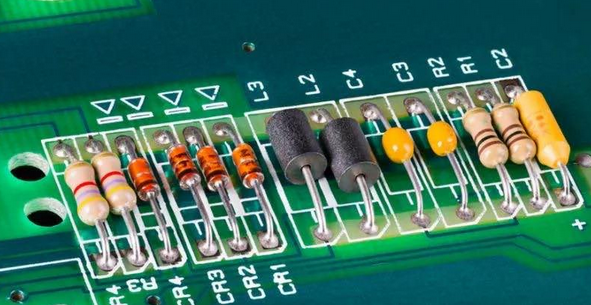
Figure 1: Composition Resistors
The resistors are distributed throughout the substrate.
2) Wirewound resistor
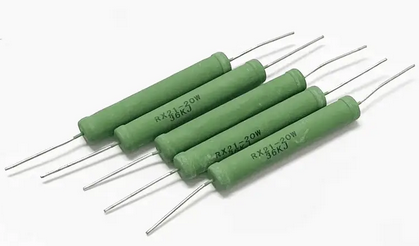
Figure 2: Wirewound Resistors
Wirewound resistors are made by wrapping metal wire around an insulating rod and then welding it to a metal end cap.
3) Thin film resistor
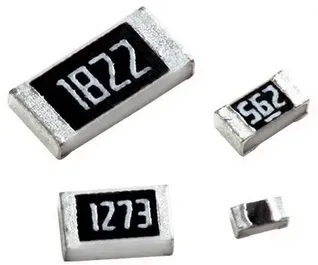
Figure 3: Thin Film Resistors
Thin film resistors are coated with a very thin layer of conductive material on a substrate.
4) Bulk metal resistor
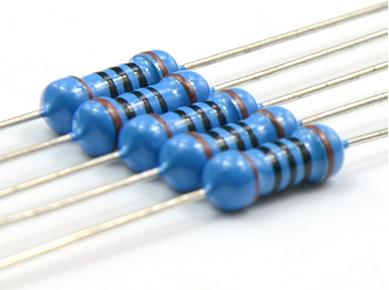
Figure 4: Bulk Metal Resistors
Bulk metal resistors have thicker metal wires or strips forming a baseless support structure.
5) Thick film resistor
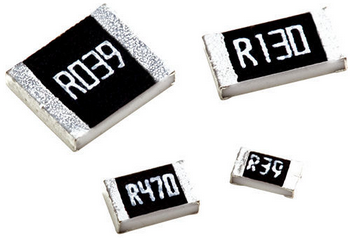
Figure 5: Thick Film Resistors
As for this type resistor, a slurry containing glass and metal particles is fired to form a resistive layer.
According to Resistor Types
Mainly introduces the following different types of circuits: chip resistors, plug-in resistors, wire wound resistors, current detection resistors, thermistors, and potentiometers, from features, applications, packaging and component selection.
1. Chip Resistor
Chip resistors have a size advantage over plug-in resistors and are ideally suited for printed circuit boards (PCBs). Some common applications are pull-up/pull-down, voltage divider, current limiting and filtering signals at certain frequencies of high pass/low pass/band pass filters. You can also use 0Ω resistors as jumpers.
There are two types of chip resistors:
1) Thin film resistor
Thin film resistors are used in applications such as high-precision audio, medical or test equipment. Compared with thick film resistors, they have lower resistance change (accuracy 0.1%-2%), lower temperature coefficient (5ppm/K) and less noise, but are more expensive.
2) Thick film resistor
Thick film resistors are the most common resistor type and are required in most applications. They have wide variation (accuracy 1%-5%), higher temperature coefficient (50 ppm/K), and are noisier than thin film resistors. If there are no specific performance requirements, thick film resistors are usually preferred.
Packages: 0201, 0402, 0603, 0805 and 1206 packages are the most common.
The numbers represent imperial sizes, 0402 is 0.04X0.02 inches, 0603 is 0.06X0.03 inches, and so on.
2. Plug-in Resistor
Plug-in resistors are popular and widely used in circuit design. The main functions are pull-up/pull-down, voltage divider, current limiting and filtering. There are many types of plug-in resistors.
Carbon film resistors and metal film resistors are the most popular among plug-in resistors.
1) Carbon film resistor
The resistance of carbon film resistors varies greatly (accuracy 2%-10%). The E12 (±10%), E24 (±5%) and E48 (±2%) packages are most commonly used. Most applications have replaced carbon film resistors with metal film resistors. The temperature coefficient (TC) of carbon film resistors is usually negative, but the exact value depends on the resistor value and size.
2) Metal film resistor
The resistance change of metal film resistors is small (accuracy 0.1%-2%) and the stability is high. It is most commonly available in E48 (±2%), E96 (±1%), and E192 (±0.5%, ±0.25%, and ±0.1%) packages. Because they have better performance than carbon film resistors and are less expensive, metal film resistors have a temperature coefficient (TC) of about ±100ppm/K - some parts have positive TC and others have negative TC.
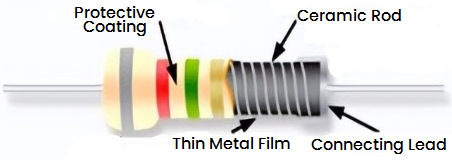
Figure 6: Metal Film Resistor Structure
3) Carbon composition resistor
Carbon composition resistor have large changes and poor stability, and have been replaced by carbon or metal film resistors. However, it has good high-frequency characteristics and is good at withstanding high-energy pulses, and is used in welding equipment and high-voltage power supplies.
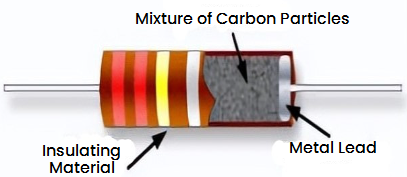
Figure 7: Carbon Composition Resistor Structure
4) Metal oxide resistor
Metal oxides were the first replacement for carbon composition resistors but are being replaced by metal film resistors in most applications. They are still used in high-endurance applications because they can handle higher temperatures and have higher power ratings (>1W). In addition, the resistance of this type of resistor is determined by the color wheel.
3. Wirewound Resistor
Wirewound resistors are made by wrapping thin wire around a ceramic rod. Used in high-precision equipment such as multimeters, oscilloscopes, and other measuring equipment. They can pass large currents without overheating are used in power supplies and other high-current circuits. Additionally, they can provide very high power ratings (up to 1000W) and can operate at very high temperatures (up to 300°C). They also have good long-term stability - 15-50 ppm/year variation compared to metal film resistors, which have a variation of 200-600 ppm/year, making them the best choice for noise performance.
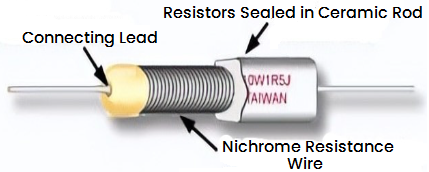
Figure 8: Wirewound Resistor Structure
Disadvantages: Only suitable for low ohm range (0.1Ω to 100kΩ). Because the winding creates resistance, they have their own inductance, which results in the worst high frequency characteristics. In addition, they are also more expensive than other common types of resistors.
Applications: Typically used in circuit breakers and fuses due to their high power capabilities.
4. Thermistor
A thermistor is a component whose resistance value changes significantly with changes in temperature. According to different temperature coefficients, they are divided into positive temperature coefficient thermistor (PTC thermistor) and negative temperature coefficient thermistor (NTC thermistor). If you need to vary resistance over a wide temperature range, use an NTC thermistor, because its resistance decreases with temperature, making them a good choice for temperature sensors between -55C and 200C. When you need a sudden change in resistance at a specific temperature, use a PTC thermistor, because it is popular in overcurrent protection applications. There are 2 important parameters here: the holding current refers to the current when the PTC thermistor is absolutely "short circuit", while the trip current refers to the current when the PTC thermistor is absolutely "open circuit".
5. Potentiometer
Potentiometers provide variable resistance and can be used in a variety of applications such as amplifier gain control, circuit tuning, etc. Trimmers are small potentiometers that can be mounted on a PCB and adjusted with a screwdriver, and can have top or side adjustment orientation. They can also be single or multi-turn. Single-turn potentiometers are used in applications such as amplifiers where only a single control is required, while multi-turn potentiometers are used for more precise control and can have up to 25 turns.
According to Resistor Parameters
1. Resistance
Resistance (R) is the main specification of a resistive element and represents the individual resistance value or resistance range provided by the element. Using Ohm's law, the voltage (V) and current (I) of the system can be used to find the required resistance value of the resistive element. The value of a resistor depends on the length, cross-sectional area, and resistivity of the resistive material from which it is made.
R=V/R (calculation formula for resistor selection)
2. Temperature Coefficient
Changes in resistance due to temperature changes are usually very small within a specific temperature range. This is because manufacturers choose materials whose resistivity is not greatly affected by temperature. That is, the material (and thus the resistance) has a low temperature coefficient. In other words, there is only a small change in the value per degree Celsius. Variations in this value are usually expressed in parts per million (ppm) and are therefore included as part of its specifications. You can check this on the datasheet. Also keep in mind that the change in resistance value with temperature changes is less dependent on changes in component size, since it will expand or contract with temperature changes.
3. Frequency Response
Ideally, a resistor should act as a pure resistor, without any of the characteristics of other types of components, and is usually treated as a pure resistor when used in DC circuits. In AC circuits, certain resistors may have properties that make them unsuitable for a particular purpose. At high frequencies, some resistors also have capacitive and/or inductive properties. Therefore, they will have a property called reactance, which is similar to resistance but depends on the frequency of the AC signal passing through the component. Additionally, the frequency response of a resistor tells us at what frequency the resistor still acts as a pure resistor without any significant influence from these other types of frequency-dependent components.
Degree of frequency response: Carbon component resistor > Thin film resistor > Wirewound resistor (worst)
4. Power Consumption
It is a measure of the amount of power a resistor can dissipate without causing overheating.
Resistors are manufactured with standard power ratings, most in fractions of 1W, while some of the larger carbon and metal resistors are available in 1W to 5W, and wirewound resistors are usually rated up to about 25W.
5. Power Derating
The power rating is the maximum power supported by the resistor. It is measured in watts (W) and describes how much heat energy a resistor can dissipate without overheating and ongoing damage. Resistors can operate at any voltage and current combination as long as the power rating is not exceeded, and the current rating and voltage rating of the component are not exceeded.
Using Joule's law, the voltage (V) and current (I) of a system can also be used to find the power in the system.
P = IV (resistor selection formula)
By substituting Ohm's law into the equation, the resistance and system current can be used to determine power.
P=I(IR)=I2R (resistor selection rated power formula)
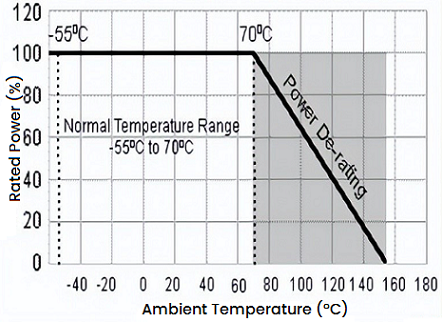
Figure 9: Rated Power Characteristic Curve
This curve shows how the specified power rating of a resistor be reduced at various temperatures above the normal operating range.
6. Maximum Temperature
Resistors are designed to operate within a specified temperature range and parameters such as tolerances and temperature coefficients cannot exceed this specified temperature range. In addition to any ambient temperatures, the most likely limit to the temperature range to be achieved in most uses will be the maximum due to the heat generated by the operating circuit.
7. Maximum Voltage
When current flows through a resistor, the voltage developed across the resistor creates electrical stress on the material the resistor is made of. If this voltage exceeds the allowed maximum value, the resistor may suddenly breakdown and a voltage flashover may occur. The maximum voltages of different types of resistors vary widely, from just a few volts for some surface mount types to several thousand volts for some specialty high voltage resistors.
When servicing equipment, it is recommended to use replacement parts from the original manufacturer whenever possible, and it is important to pay close attention to the manufacturer's service manual for the specific device you are working on.
8. Tolerance (Accuracy)
Tolerance is a measure of the accuracy of a resistor. A lower tolerance means the resistor deviates less from the indicated resistance value. For coded independent resistors, the fourth color usually indicates accuracy. The absence of a tolerance zone typically indicates an accuracy of ±20%. The actual resistance of a 1kΩ resistor with gold accuracy (±5) can be any value between 950Ω and 1050Ω.

 English