An infrared sensor is a common electronic device used to detect and receive infrared radiation. They are widely used in various fields, such as remote controls, security monitoring, thermal imaging, etc. This article will explain how infrared sensors work and the different types of infrared sensors.
Infrared (IR) Sensor Basic
Working Principle
The working principle of infrared sensing is based on the propagation of infrared radiation and the reflection of objects. Infrared radiation is a kind of electromagnetic radiation with a longer wavelength and cannot be directly seen by the human eye, but it can be detected by specific infrared sensing equipment. When the temperature of an object is higher than absolute zero (-273°C), it emits infrared radiation, and the intensity of the radiation is proportional to the temperature of the object.
Infrared sensing devices usually consist of a transmitter and a receiver. The emitter emits infrared rays of a certain wavelength, and the receiver receives the radiation reflected from the object. When an object approaches a sensing device, the infrared radiation received by the device is enhanced. This is because the object absorbs some of the radiation and reflects it back, causing the receiver to get a stronger radiation signal, which is then converted into an electrical signal and processed through the circuit. Finally, the processed signal will be sent to the controller or alarm to trigger the corresponding operation. Infrared sensors are based on this principle.
As a component that can sense the infrared energy of an object and convert it into an electrical signal, the infrared sensor consists of three parts: an optical system, a detection element and a conversion circuit.
Optical systems can be divided into two categories: transmission type and reflection type according to different structures. The transmission type requires two components, one for transmitting infrared rays and one for receiving infrared rays. While the reflection type only requires one sensitive element to collect the required information.
Detection elements can be divided into thermal detection elements and photoelectric detection elements according to their working principles. The most commonly used thermal element is the thermistor. When it is exposed to infrared radiation, the temperature increases and the resistance changes (this change may be larger or smaller, because it can be divided into positive temperature coefficient PTC thermistors and negative temperature coefficient NTC thermistors), and becomes an electrical signal output through a conversion circuit. Photoelectric detection elements are commonly used photosensitive elements, which are usually made of materials such as lead sulfide, lead selenide, indium arsenide, antimony arsenide, mercury cadmium telluride ternary alloy, germanium and silicon doping.
According to the different signal processing conversion circuits, infrared sensors can be divided into two categories: analog type and digital type. The signal processing circuit of the analog pyroelectric infrared sensor is a field effect transistor, while the signal processing circuit of the digital pyroelectric infrared sensor is a digital chip.
Basic Rules
Kirchhoff's law: At a certain temperature, the ratio of the radiation flux W and the absorption rate per unit area of the ground object is a constant for any object, and is equal to the blackbody radiation flux W of the same area at the temperature. At a given temperature, the emissivity of an object is equal to the absorption rate (same band): the greater the absorption rate, the greater the emissivity. In addition, the thermal radiation intensity of ground objects is proportional to the fourth power of temperature. Therefore, small temperature differences of ground objects will cause obvious changes in infrared radiation energy. This characteristic forms the theoretical basis of infrared remote sensing.
Boltzmann's law: The total radiation flux of a black body increases rapidly with the increase of temperature, which is proportional to the fourth power of temperature. Therefore, small changes in temperature will cause large changes in radiation flux density. It is the theoretical basis for infrared device temperature measurement.
Wien's displacement law: It describes one of the relations between the emission spectrum of a black body and its temperature. As the temperature increases, the peak wavelength corresponding to the maximum radiation moves toward the shortwave direction.
Classifications
According to different working principles and application requirements, infrared sensors can be divided into the following types:
1. Passive Infrared Sensor (PIR)
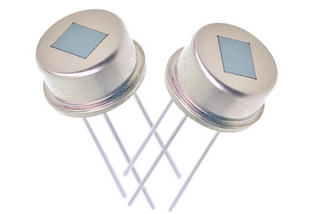
Passive infrared sensors are based on the working principle of thermistors and are mainly used for human body detection and safety monitoring. They can detect infrared radiation emitted by human bodies and determine the presence of a person based on changes in heat. PIR are widely used in smart homes and security systems.
2. Active Infrared Sensor
Active infrared sensors use their own emitted infrared radiation for detection. They generally consist of an infrared transmitter and a photodiode, capable of sending and receiving infrared signals. They are commonly used in applications such as remote controls, infrared communications, and object detection.
3. Infrared Thermal Imaging Camera
A infrared thermal imaging camera is an advanced sensor that can measure the temperature distribution on an object's surface and generate a heat map. They work by capturing the infrared radiation emitted by an object, using technologies such as thermal sensors or micropinhole arrays to resolve temperature differences and convert them into visual images. And they are widely used in thermal imaging, building inspection, medical diagnosis, military reconnaissance and other fields.
4. Infrared (IR) Photodiode
Infrared photodiode is a special type of sensors, consisting of a light-emitting diode and a photosensitive diode. They are often used for proximity detection and occlusion detection, for example, they can determine the presence or position of an object by measuring whether infrared light is blocked or reflected. IR photodiodes are widely used in automation control, manufacturing and robotics.
In summary, infrared sensors are based on different working principles and application requirements, including thermistor, photodiode, thermal imaging and infrared phototube types. Each type of infrared sensor has unique advantages and applications. Choosing the right infrared sensor depends on the specific needs to ensure accurate and reliable detection and reception of infrared radiation.
* Here are some common infrared sensors:
1. Thermometrics Infrared (IR) Sensors
Thermometrics IR sensors use changes in heat to detect infrared radiation. They usually consist of one or more pairs of thermistors whose sensitivity to infrared light changes with temperature. When infrared radiation acts on a resistor, the temperature of the resistor changes, causing a change in the resistance value. By measuring changes in resistance, the intensity of infrared radiation or the presence of an object can be determined.
2. IR Photodiode Sensor
IR photodiode sensors detect infrared radiation based on the photoelectric effect. They usually consist of an infrared light source and a photodiode. When infrared radiation strikes a photodiode, the photons excite the charge within the diode, creating an electric current. By measuring changes in current, the intensity of infrared radiation or the presence of an object can be determined.
3. Thermal Imaging IR Sensor
Thermal imaging infrared sensors use the infrared radiation of the object itself for detection. They measure the temperature distribution on an object's surface and convert it into an image display. This sensor works by capturing infrared radiation emitted by an object, using technology such as thermal elements or micropinhole arrays to resolve temperature differences and generate a heat map.
Advantages
1. High Sensitivity
Detection of heat sources is so sensitive that temperature changes are captured almost instantly. This makes infrared sensors have extremely high application value in fire warning, security monitoring, non-destructive testing and other fields.
2. Contactless Measurement
IR sensors can measure the temperature of an object within a certain distance without contact with the object. Such characteristics enable it to ensure both measurement accuracy and user safety when working in harsh environments such as high temperature and high pressure.
3. Real-time Monitoring
Real-time monitoring can be performed to provide us with real-time data. In industrial automation, smart home, medical and health, etc., the function of real-time monitoring makes infrared sensors an indispensable part.
4. Easy to Integrate
IR sensor is small in size, light in weight, has rich interfaces, and is easy to integrate into various devices. This enables IR sensors to be widely used in daily necessities such as smartphones and wearable devices, providing convenience to our lives.
5. High Reliability
Infrared sensors can still maintain stable working performance in harsh environments and are not susceptible to interference. They are popular in engineering applications.
6. Wide Operating Temperature Range
They can work in an extremely wide temperature range and are not affected by temperature changes. This provides the possibility for the application of infrared sensors in extreme environments and expands its application fields.
7. Energy Saving and Environmental Protection
The energy loss during the working process is small, which is in line with the concept of green environmental protection. In the context of energy conservation and emission reduction, infrared sensors, as a green technology, have received widespread attention and attention.
Application Examples
An infrared sensor is a device that can sense infrared radiation in the surrounding environment. It has a wide range of applications in many fields:
1. Home appliance control: IR sensors are widely used in remote controls, smartphones, TVs, air conditioners and other equipment. Remote control can be achieved through infrared sensors, and users can control the device's switches, volume, channels and other functions by sending infrared signals.
2. Security monitoring system: IR sensors can be used to sense the heat of human bodies or animals to monitor and alarm intruders. What’s more, it can also be used in night vision cameras to achieve shooting and tracking at night through infrared radiation.
3. Automation system: By sensing the approach or departure of the human body, IR sensors can automatically turn on and off devices, such as automatic doors, automatic sensor faucets, etc. improving the convenience of life.
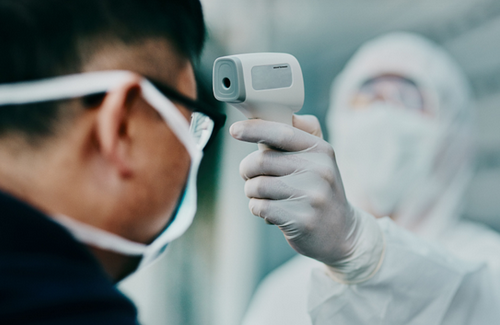
4. Medical equipment: In the medical field, IR sensors are used in medical equipment such as thermometers and blood glucose meters to measure body temperature and blood sugar levels by sensing infrared radiation from the human body.
5. Industrial production: In the field of industrial automation, IR sensors are used for material detection, positioning and counting on production lines. Because it can quickly and accurately sense the position and motion status of objects, achieving precise control in the automated production process.

 English