Slow blow fuses are used in circuits where you can normally expect brief peaks above the fuses power rating. For example, this may happen at power up for some amps and be totally normal. As long as the circuit current doesn't stay above the peak for any significant length of time there is nothing wrong. That being the case you don't want the fuse to blow with short current peaks so a slow blow is specified. What does that even mean? Should I use it or not? How "slow" it is? Let's get the answers from this complete guide.
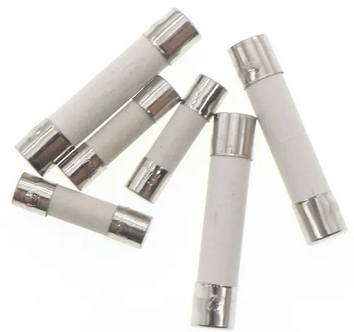
What Is Slow Blow Fuse in Circuit?
Terminology
A slow-blow fuse is a type of fuse designed to handle temporary surges in current without immediately blowing. It is engineered to tolerate brief spikes in current, such as those occurring during the startup of electrical devices or normal operational fluctuations, without interrupting the circuit. This is achieved through a design that allows the fuse to delay its response to overcurrent conditions, typically by using a longer and coiled wire that increases the thermal path and cooling time, thus requiring a sustained elevated current above its rating for a specific duration before it will blow. This characteristic makes slow-blow fuses particularly useful in applications where intermittent or brief overloads are expected, such as in electronic circuits, appliances, and electrical systems where sensitive components need protection from short-term overloads.
Construction
Slow blow fuses typically consist of a metal wire or strip (the filament) housed in a non-combustible casing, often made of glass or ceramic. The filament is designed with specific materials to control the melting point and heating characteristics. Additionally, some fuses include sand or a similar filler to quench the arc created when the filament melts, enhancing safety. The casing also provides insulation and protection from external elements.
The filament designed to heat up gradually, allowing for short-duration current spikes without melting immediately. When a sustained overcurrent occurs, the filament heats up sufficiently over time, causing it to melt and break the circuit. This delay ensures that transient surges, like those from motor start-up, do not trigger the fuse, providing ultimate protection against damage. The construction typically involves materials that can withstand higher temperatures, allowing for the time delay before failure.
Characteristics of Slow Blow Fuse
Several points determine whether a fuse is classified as slow blow:
1) Time-Current Characteristics: Slow blow fuses have a longer time delay before they trip, allowing them to handle temporary overloads.
2) Filament Design: The material and thickness of the filament influence how quickly it heats up and melts under current.
3) Ambient Temperature: The fuse's ability to withstand higher temperatures without tripping can affect its classification.
4) Application: Fuses designed for specific devices with known inrush currents (like motors) are often made slow blow.
5) Testing Standards: Manufacturers follow specific standards and ratings that define the fuse's delay characteristics.
Slow Blow Fuse Types
There are several types of slow blow fuses, each designed for specific applications and environments. Here are some common types:
1. Glass Tube Fuses:
• Transparent casing allows for visual inspection.
• Common in household applications.
2. Ceramic Fuses:
• More durable than glass and better for high-temperature applications.
• Often used in industrial settings.
3. PCT (Polymer Coated Thermal):
• Provides added protection against moisture and environmental factors.
• Suitable for outdoor or humid environments.
4. Automotive Fuses:
• Designed for vehicles, typically in blade form.
• Protects electrical systems in cars from surges.
5. Class H and K Fuses:
• Used in industrial applications, designed for high fault current ratings.
• Class H is time-delay, while Class K is even more tolerant of inrush currents.
6. Resettable Fuses (PTC Fuses):
• Polymer-based and reset automatically after a fault condition.
• Useful in electronics and low-voltage applications.
7. Dual Element Fuses:
• Contain both a fast-acting and a slow-blow element for layered protection.
• Suitable for mixed-load applications.
Common Slow Blow Fuse Applications Near You
Common Applications
These fuses are essential in applications where components experience brief current spikes but should not be interrupted during normal functioning, including:
1. Electric Motors: Protects against start-up surges without tripping during normal operation.
2. Transformers: Safeguards against inrush current when the transformer is energized.
3. HVAC Systems: Protects compressors and other components from overloads.
4. Power Supplies: Used in devices that may have transient current spikes, ensuring stable operation.
5. Home Appliances: Common in appliances like refrigerators and washing machines that have motors.
6. Lighting Circuits: Protects against initial surge currents in fluorescent and LED lighting fixtures.
Should I Use Slow Fuse or Fast Fuse?
Two Concepts
• Slow blow fuses are used where large short term transients are known to occur and if sizing of the fuse to accommodate the transients will result in inadequate protection against typical faults.
• Fast blow fuses are used where possible, where the fuse can be sized such that typical faults will always cause it to blow but nuisance blowing is rare. Some situations have little or no startup surges or large occasional current excursions.
Where neither fast or slow blow fuses offer adequate protection (transients are very high but faults may be relatively low compared to maximum usual) then a circuit breaker can be used, whose characteristics can be mapped accurately to a desired time/current profile.
Two Dominant Positions
• Fast blow is the "more ideal" where possible.
1) Circuit current is well defined within known limits.
2) Start up transients are not so large compared to typical current that allowing for them is going to cause problems.
3) Fault currents are liable to be much much larger normal operate current and much larger than expected transients.
• Slow blow is a compromise that allows protection while accommodating expected transient behaviour.
1) Startup or other transients may occur which cause much higher than average currents but for short periods.
2) Sizing a fast-blow fuse to allow the transients would result in a fuse which may not provide protection during some expected fault conditions.
In summary, the primary difference between a slow blow fuse and a fast (normal-acting) fuse lies in their response to current surges. A slow blow fuse is designed to withstand temporary overloads without blowing, making it suitable for applications like motors that experience start-up surges. In contrast, a fast fuse reacts quickly to overcurrent conditions, providing immediate protection against short circuits or overloads. This means slow blow fuses are ideal for devices with transient spikes, while normal fuses are better for consistent, immediate overcurrent protection. Of course, the ideal may be both a fast and slow blow fuse in series (very unusual and possibly also illegal for regulatory reasons) or a circuit breaker with a well defined current versus time "envelope". Last but not least, regulatory requirements often make it clear which sort of fuse must be used.
You May Also Like

 English