a dream come true
‘Convenience’ is a desire rooted in human nature. We work hard and earn money to make life easier and more convenient. Smart home technology is driving significant advances in home automation. We expect our home environments to serve us better, allowing us to live a more relaxed, comfortable, and safe life, while also being more environmentally friendly.
Years ago, there were traditional home systems for HVAC, security alarms, lawn sprinklers and home entertainment. However, only network-based, connected controls can truly improve convenience. In the past, to adjust the sprinkler system every daylight saving time, you might have had to rummage through a box to find the manual. Now, it's easy to manage everything with an app on your phone, and many of the basic settings can be done automatically.
Building Smart Home Applications
In order for a smart home system to be able to sense its surroundings, sensors usually need to be placed throughout the house. While traditional sensors are primarily used to detect light, temperature and motion, more modern sensors are equipped with image recognition and other highly intelligent identification capabilities. These sensors can not only detect how many people are in a room, but can also tell whether a friendly cat has walked up to the door or whether a burglar is peering out of the window, waiting for a chance to steal property.
To save costs and increase flexibility, such sensors should be able to operate wirelessly. This way, the sensors can be easily deployed in existing homes and make the most of suitable installation locations. Today, thanks to wireless communication such as Wi-Fi or Bluetooth®, data communication is no longer a challenge. However, all sensors require power. For most applications, power availability remains a challenge. While energy can be harvested using common photovoltaic cells, regular batteries are still the preferred method of power supply. The biggest issue for smart home systems is battery runtime. In order to make simple batteries practically usable and to improve the cost-effectiveness of photovoltaic cells, sensors need an efficient power supply. Standby current and full-load operating efficiency are critical design factors for any smart home system.
High-efficiency power supply with single-cell boost converter
A simple way to power distributed sensors is to use primary batteries, which are disposable, non-rechargeable batteries. Such batteries provide a good balance between circuit cost, hardware composition, and cost of ownership, including the cost and experience of replacing or recharging them. Typically, a new primary battery provides 1.5 V. After discharge, the battery voltage drops below 0.8 V. Different types of chemical batteries produce different voltage profiles during discharge. However, in general, once the voltage falls below 0.8 V, the battery is difficult to discharge and cannot be used further.
Many electronic circuits operate at voltages higher than 0.8 V. To better match the supply voltage to the operating voltage, multiple cells can be used in series. However, multiple cells cost more and require more space than a single cell. Therefore, there are very efficient boost regulators on the market that can step up the typical raw cell voltage of 0.8 V to 1.5 V to the voltage required for smart home applications, such as 3.3 V or even 5 V. Figure 1 shows a small boost converter circuit using the MAX18000.
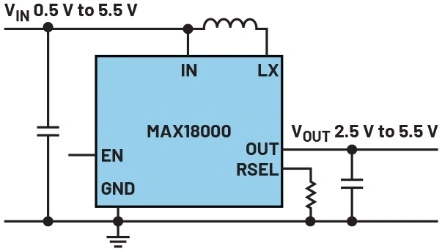
Fig. 1. a simple but efficient single cell boost converter
The circuit is compact and requires only a few external components, and the DC-DC converter IC itself is available in a 1.07 mm × 1.57 mm package. The boost converter has two built-in 3.6 A switches. After the output voltage is up and running, the quiescent current is only 512 nA. Peak efficiency is 95%, and low load efficiency (load current above 20 μA) is still above 90%. The input operating voltage range of 0.5 V to 5.5 V enables very low battery voltages (e.g., 0.8 V) to be stepped up to useful higher system voltages.
High Efficiency Power Supplies with Buck-Boost Converters
Some sensor applications run on multiple batteries or a single lithium-ion battery. In this case, the required voltage is slightly higher than the example above. The typical voltage value of a fully charged Li-Ion battery is about 3.7 V. When the battery is discharged, the lowest voltage value is about 2.8 V, below which the battery is essentially depleted. For this voltage range (i.e. 2.8 V to 3.7 V), a buck-boost solution is required to generate the nominal 3.3 V in order to run the common electronic components of a typical sensor circuit. That's why buck-boost converters are gaining traction with the rise of lithium-ion batteries.
A similar need exists when using three 1.5 V primary batteries in series. They provide a total of 4.5 V when fully charged, but when nearly depleted, these batteries only provide about 2.4 V. A buck-boost solution is also required to generate a fixed 3.3 V voltage for the sensor.
Figure 2 shows a buck-boost solution using the MAX77837. This solution requires only a few external components, so the required printed circuit board area is very small. In addition, the chip itself is available in a very small package size of 1.84 mm × 1.03 mm, and sensor manufacturers wishing to use a package with a larger pitch (distance between pins) can choose a 2.5 mm × 2 mm QFN package. To maximise battery life, the solution requires only 430 nA typical quiescent current. When switched off, the power conversion IC draws only 10 nA. This can be useful in applications where there is an energy storage capacitor next to the main battery, and the DC-DC converter can be left in shutdown mode for a period of time before restarting and charging the capacitor again. In the long run, this solution saves more power and extends the battery runtime.
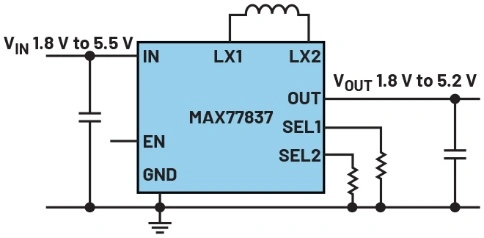
Fig. 2. Ultra-efficient buck-boost converter for generating voltages above or below the input voltage
Simplifying Design with Circuit Simulation
When designing a battery-powered sensor, some basic questions about the capabilities and limitations of the power supply circuit must be addressed. It makes sense to perform circuit calculations and simulations at this stage, not only to save time, but also to reduce the risk of starting a hardware design with an unsuitable integrated circuit. To help users get started with their designs quickly, ADI offers the free EE-Sim® Power Tool. When using this tool, users simply type in the input voltage, output voltage, and current requirements, and the tool instantly calculates a suitable circuit. Figure 3 shows an example of a circuit simulation result in EE-Sim® Power.
Based on this circuit calculation, the tool can perform a circuit simulation based on actual external components, giving waveforms for different voltages and currents. The tool can also perform advanced simulation tasks such as load steps, AC loops, line transients and efficiency.
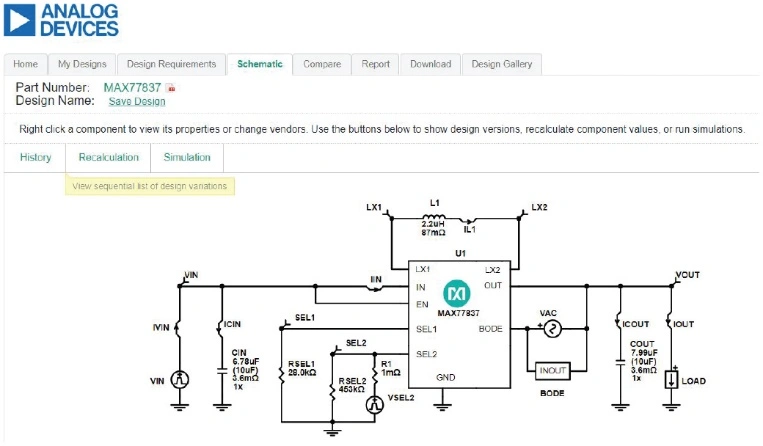
Fig. 3. Designing and Simulating Circuits with EE-Sim® Power Tools
Entry-level hardware
Theory and simulation are important, but the actual hardware can be very different. In addition to evaluation boards for individual power converters, ADI offers complete, practical sensor systems for evaluation. These include the Smoke Detection System, a multi-standard micropower validated smoke detection system module. It shows how the MAX77837 and ADP162 can power a complete smoke detector. The smoke detector consists of three devices including the ADPD188BI, an integrated optical module for smoke detection; the MAX32660 with smoke and fire detection algorithms; and the MAX31875, a digital temperature sensor. click here to download all the associated design files to make it easy for developers to build high-quality smart home sensors with nanopower features. This fully optimised and validated sensor hardware includes the necessary software and demonstrates the functionality of the power management circuitry.
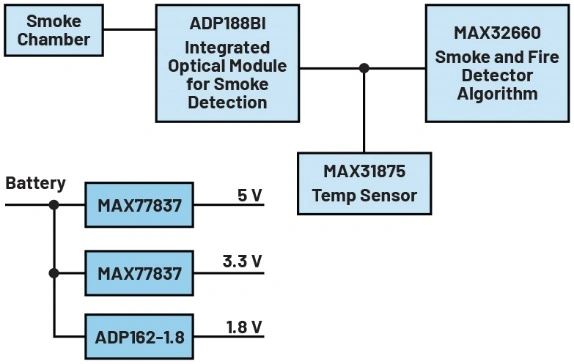
Fig. 4.Multi-criteria micropower validated systematic module for smoke detection
Reach a verdict
Power management is critical to enabling the smart home. It ensures efficient power conversion, which extends the runtime of small, low-cost batteries. Currently, sensors on the market have many features such as robust connectivity. In order for battery-powered or energy-harvesting-powered systems to be practical for a wide range of sensors, the quiescent current of buck, boost and buck-boost converters must be very low. Innovations in semiconductor processes and integrated circuit design are helping to meet this requirement. And this is just the beginning of the many innovations that will come to the connected home in the future as power management technology advances, giving rise to even smarter sensors.

 English