Network edge AI - i.e., deploying AI models for localised algorithmic processing at the edge device end, rather than relying on centralised computing platforms such as the cloud - has become one of the fastest-growing directions in the field of AI and is receiving a high level of attention from the industry. The network edge AI market is estimated to be around $21 billion in 2024 and is expected to surpass $143 billion by 2034. This growth trend indicates that industries will continue to increase investment in R&D of AI-based edge systems.
The applications of network edge AI are promising and full of innovation opportunities, covering a wide range of fields such as self-driving cars, smart home devices, and industrial automation machinery. However, developers need to address unique challenges such as hardware limitations, power optimisation and processing complexity in practice. For example, designers must ensure that embedded AI models have sufficient arithmetic power to parse real-time contextual information directly on the edge device side while maintaining a compact size. This requires the system to achieve an optimal balance of performance metrics such as latency control, bandwidth efficiency, computational accuracy, and sustainability, while also safeguarding data privacy and reducing the risk of cyber threats.
The evolution of applications at the edge of the network is advancing in tandem with the development of contextual intelligence. Contextual intelligence aims to understand the meaning of data in terms of its environment, associations, and interaction scenarios, giving rise to contextual edge AI, which enables systems to process ambient data, continuously learn, and optimise performance by running AI models on the device side of the network edge. For example, smart devices understand their surroundings through multiple perceptual modalities, such as vision and hearing, and this ability to efficiently process contextual data is key to achieving the functional goals of network edge devices and enhancing user experience. As the amount of data processed at the edge proliferates, these devices require higher computing power to support them.
The flexibility, field-scalability and interoperability of field-programmable gate arrays (FPGAs), combined with their low-power, low-latency and parallel processing capabilities, make them a key tool for developers to overcome the challenges and optimise AI applications at the contextual edge.
The Challenges of Achieving Context-Aware Edge AI
By directly analysing contextual data on devices at the edge of the network, systems can make smarter, real-time decisions that drive a more symbiotic relationship between users and devices. For example, a smart computer monitor could use user presence data securely collected by visual sensors to optimise power usage hours by turning on when the user turns to the screen and turning off when the user leaves. Smart cellular devices could similarly utilise facial or fingerprint recognition technology to securely check biometric or user visual data, access user credentials and log into secure applications.
While users have come to expect these seamless, personalised experiences with contextual edge AI, developers may face a variety of development challenges. These challenges include:
1. Complexity
The contextual data collected by edge sensors is becoming more complex as organisations try to further simplify the human-machine interface. This requires AI models and hardware that can handle higher workloads while maintaining efficiency. Network edge AI also requires flexibility, as models and hardware may need to be updated regularly to cope with changing contextual data. Edge AI may also involve the use of TinyAI models, whose compression algorithms are better suited to achieve high performance in network edge scenarios, including wearables, remote sensors for environmental monitoring, and quality control in industrial IoT applications. Even so, the TinyAI model requires adequate power and system support to operate effectively.
2. Interoperability
In order to obtain as much relevant contextual intelligence as possible, edge networks typically include a variety of sensors, processors, gateways, and servers. Each of these components needs to effectively communicate with each other to support real-time results. Network edge devices must be able to handle growing AI workloads while also operating in concert with other devices in the network, whether existing components or third-party hardware and software. Without flexible hardware, connectivity between sensors, edge devices, and data analytics recipients will become unreliable.
3. Power consumption
Advanced AI models require large amounts of energy to operate, and researchers expect that AI-related power consumption is expected to grow by up to 50 per cent per year from 2023 to 2030. Stable, energy-efficient delivery of energy to models is therefore critical. If not configured with efficiency in mind, edge deployments are likely to experience excess energy consumption, rising costs, and large delays between the execution and results of AI operations at the edge of the network.
Only by taking these challenges into account and proactively overcoming them will developers be able to leverage contextual edge AI to improve the user experience.
Easy Contextual Edge AI with Lattice FPGAs
Overcoming complexity, interoperability and power consumption challenges is a multifaceted endeavour that requires flexible application of hardware and software. Lattice sensAI™, a collection of low-power Lattice FPGAs optimised for AI and solutions for industrial intelligence applications, is ideally suited to address implementation challenges and enable context-aware edge AI applications.

Lattice FPGAs are configured to perform specific AI tasks, enabling developers to tailor applications to different environments and process specific edge data. This helps optimise edge AI applications for maximum efficiency and reliability while maintaining the flexibility of the FPGA to support evolving AI models.The FPGAs are also equipped with customisable I/O interfaces to support connectivity across devices and environments (e.g., cameras, radar, environmental sensors) to a wide range of edge AI applications and enable simpler interoperability.
This customisation is further supported and enhanced by the Lattice sensAI solution set. Lattice sensAI is able to take models trained in industry-standard AI frameworks such as TensorFlow, Caffe and Keras and enable them to run on FPGA resources through techniques such as model quantisation, pruning and sparsity exploitation. Lattice's neural network compiler can then analyse the model and suggest the most efficient run based on the type of circuit and on-chip network. In addition, Lattice Propel and Lattice Radiant design software can be used to create the right combination of circuits to accelerate the operation of these models in the most energy-efficient way possible.
Lattice FPGAs also dramatically reduce the latency between sensor data acquisition and processing, giving users faster response and higher performance. Data can complete preprocessing and aggregation tasks on the FPGA before being transferred to the AI model or central compute engine, which helps reduce stress on devices at the edge of the network, which in turn reduces power consumption.
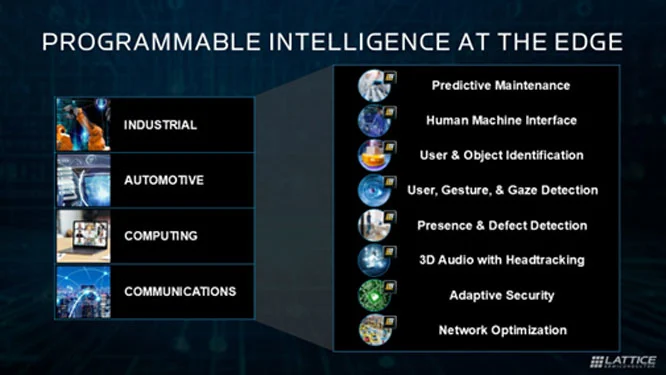
Industries can leverage Lattice FPGAs to overcome resource constraints, power consumption, connectivity and scalability challenges. The real-time data processing and prediction enabled by these programmable devices is critical for applications in industrial equipment, medical devices, automotive and robotics. the adaptability of FPGAs allows for the tailoring of AI solutions to meet the specific needs of a variety of environments, ensuring optimal performance and reliability.

 English