The Future Development of Hot-Swap Controllers in Data Centres
As AI workloads intensify, GPUs within server environments are generating unprecedented power demands, driving the transition of cabinet-level power architectures towards 800V systems. This high-voltage architecture introduces new challenges for system protection and monitoring, particularly during hot-swap operations involving power-connected racks. To address these challenges, a new generation of hot-swap controllers is required: not only capable of managing high-voltage inrush currents, but also providing reliable telemetry to support system diagnostics and safety protection. ADI, recognised as a leader in 12V and 48V hot-swap technology, is now extending this expertise to the 800V domain to support the industry's transition to high-voltage architectures.
Why is the 800V architecture so crucial?
Within AI server infrastructure, two core trends are driving the transition towards higher voltages for cabinet-level power supply.
- Continuous rise in GPU power consumption: As GPU computational performance continues to increase, their power requirements are also rising significantly.
- Increased single-cabinet compute density: To maximise performance in large-scale AI training and inference scenarios while minimising interconnect latency, an increasing number of GPUs are being consolidated into individual cabinets. This co-location approach not only enhances bandwidth efficiency by shortening data transmission paths between accelerators but also reduces communication overhead.
To meet the resulting surge in cabinet-level power demands, the industry is progressively adopting distributed power architectures. Under this model, traditional power components—such as power distribution units (PDUs), battery backup units (BBUs), and capacitor units (CUs)—are no longer deployed within the main IT cabinet. Instead, they are relocated to adjacent power-side cabinets (sidecars). This separation not only supports higher-voltage power transmission (e.g., 800V) but also frees up valuable cabinet space for accommodating additional computing resources.
Existing power supply methods
The AI rack employs a 48V busbar for power supply (see Figure 1). AC power is converted to 48V DC power (VDC) by the power supply unit (PSU) within the cabinet. The 48V bus supplies power to the following equipment: IT equipment (including server PSUs, GPU nodes, switches), battery backup units (BBUs) with integrated bidirectional DC-DC converters, and supercapacitor units (SCUs) for rapid transient support and transient handling.
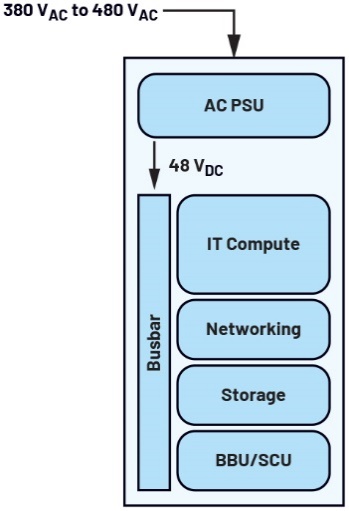
Figure 1. 48V cabinet power supply architecture for data centres.

Figure 2.48V AI Server.
Each node on the cabinet (such as a server tray) must be capable of being connected and disconnected whilst the equipment remains operational. Consider this scenario: a technician arrives on-site to replace a server. Shutting down the entire cabinet to replace a single server is impractical. Such an operation would cause significant disruption to the data centre's operations, not to mention the substantial losses incurred by server downtime. Cabinets are only taken offline in the event of major power issues, such as faults related to the busbar or facility power supply. Beyond this, all nodes employ hot-swap functionality: technicians can remove the node requiring replacement, complete the swap, and reinsert it without shutting down any other equipment.
During this process, the node's hot-swap controller internally disconnects its power supply to ensure safe removal, while the cabinet bus remains energised to continue supplying all other nodes, the BBU, and the SCU. Upon installation of the replacement node, a pre-charge circuit limits inrush current before full energisation – a critical function of the hot-swap controller. Subsequently, the replacement node will automatically power up and rejoin the AI cluster (typically with load rebalancing handled by orchestration tools).
Figure 2 illustrates the power distribution from the 48V bus to the processor within an AI server, clearly labelling the hot-swap controller as the ‘first interface’ to enable technicians to remove nodes safely and efficiently.
ADI offers an extensive portfolio of 48V hot-swap controllers featuring PMBus® power monitoring capabilities. Examples include the LTC4286 and LTC4287, both housed in 7 mm × 7 mm QFN packages and employing single-gate and dual-gate architectures respectively. Recently, the product line has been expanded with the addition of the LTC4284 dual-gate solution, packaged in a 5 mm × 8 mm QFN.
Evolving towards higher voltages
As the power consumption of AI processors continues to rise, cabinet-level high-voltage direct current (HVDC) power distribution is emerging as a new development direction. ADI stands at the forefront of this technology and collaborates closely with industry-leading enterprises to jointly address related challenges.
New power distribution voltage levels (±400V or 800V) have been defined at the cabinet side, delivered directly from the supply-side cabinet to the IT cabinets. Figure 3 illustrates this proposed architecture.
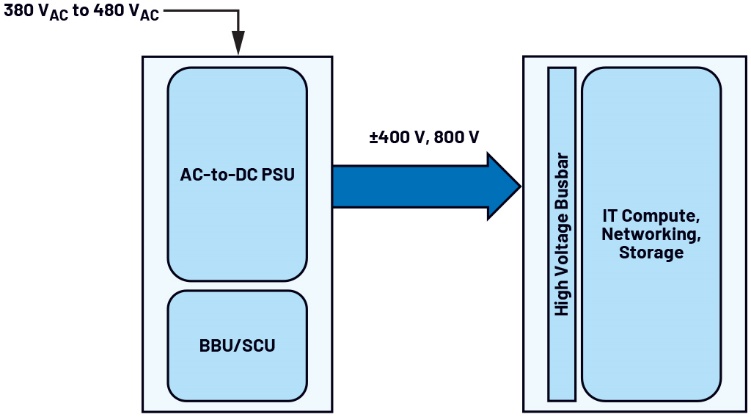
Figure 3. Data Centre ±400V/800V Cabinet Power Supply Architecture.
The primary driver behind the transition to higher cabinet-level voltages is the ever-increasing power requirements of individual cabinets. As power delivery increases, the current flowing through busbars correspondingly rises. To maintain acceptable thermal and electrical performance, higher currents necessitate larger, heavier busbars, presenting significant challenges in mechanical feasibility and system design. By elevating the supply voltage, the required current can be proportionally reduced, enabling the use of more compact and manageable busbars and interconnect components. This transition to higher voltages is crucial for achieving scalable, efficient, and mechanically viable power distribution within next-generation AI server cabinets.
It is worth noting that a transitional phase may occur during this architectural evolution, where 48V busbars continue to be utilised within the cabinet. In this scenario, PSUs would be upgraded to higher power ratings, receiving ±400V/800V voltages at the cabinet side before step-down conversion to 48V to interface with existing 48V busbars. However, this is not a long-term solution due to its limited power delivery capacity (potentially capping at 250kW per cabinet). whereas the industry objective is to maximise per-cabinet computing power, aiming to increase per-cabinet power delivery to 1MW by the end of this decade. Consequently, the optimal deployment location for PSUs and BBUs is outside IT computer cabinets, as illustrated in Figure 3.
In the future, solid-state transformers are anticipated to be deployed, enabling direct high-voltage distribution to each IT computer cabinet without reliance on these supply-side cabinets.
Hot-swap technology reaches new heights
ADI possesses extensive expertise in data centre power solutions and is collaborating with cloud service providers and semiconductor manufacturers to develop next-generation cabinet-level high-voltage power supply solutions.
Achieving high-voltage hot-swap capability necessitates addressing numerous design considerations and overcoming various technical challenges to deliver an optimal solution.
- Power density: Power density is a critical factor, as ±400V/800V hot-swap circuits must ultimately be integrated onto server cards within IT cabinets. Space on these server cards is extremely precious, and as cabinet density increases—meaning more servers are integrated into a single cabinet—space constraints become increasingly stringent. Therefore, high-voltage hot-swap solutions must be designed to occupy as little space as possible.
- High-voltage control and protection: The transition to ±400V and 800V voltages presents significant safety challenges. The risk of electric shock at 48V is negligible, whereas high voltages can be life-threatening. Consequently, hot-swap circuits must handle substantial current surges within microseconds, making precise control paramount. Regulating the surge current rise time is central to this, preventing damage to cabinet equipment while safeguarding technicians. Additionally, the system must coordinate timing, detect overcurrent or undervoltage events, and facilitate a smooth shutdown when necessary.
- Telemetry: As the first component in the node power supply path, the hot-swap controller serves as an ideal location for data acquisition. It must accurately measure voltage, current, and power to meet system specifications, whilst also logging events such as overcurrent, undervoltage, and thermal shutdown. Furthermore, the hot-swap controller should report temperature data from the power switch (MOSFET) or the adjacent printed circuit board (PCB) area. Precise hot-swap telemetry delivers significant system benefits: real-time load current analysis improves energy demand forecasting. Historical current data collected during hot-swap operations supports predictive maintenance (e.g., identifying anomalies before PSU failure) and informs cabinet-level power distribution capacity planning models. ADI is actively developing new high-voltage hot-swap controller solutions to support emerging cabinet-level power architectures. Leveraging proven intellectual property in power protection and telemetry, ADI is extending its technical capabilities into the ±400V and 800V domains. Through collaboration with leading data centre OEMs and power switch suppliers, ADI's next-generation solutions are designed to fully address the evolving requirements of hot-swap systems, including compact form factors, precise high-power control, and enhanced data acquisition accuracy. These innovations are critical for ensuring the safe and efficient operation of high-voltage AI server environments.
Conclusion
This paper highlights key trends in the transition of AI server cabinets towards 800V power supply architectures. This shift aims to meet the escalating power demands of advanced GPUs while supporting higher computational densities. The new architecture relocates power components to dedicated power-side cabinets, thereby optimising space allocation for computational resources within the main cabinet. ADI remains at the forefront of this technological advancement, having developed next-generation high-voltage hot-swap controllers that effectively manage inrush currents, deliver comprehensive system diagnostics and safety telemetry, and ensure operational reliability. By examining the evolution of cabinet power supply from a systems perspective, developers can empower cloud server providers and system integrators to gain new insights and achieve cost efficiencies.

 English