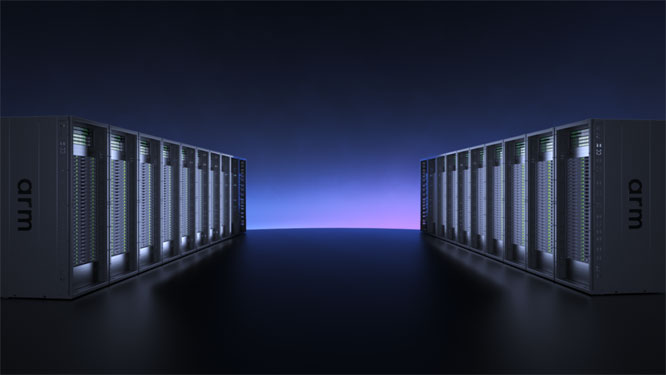
As artificial intelligence (AI) systems evolve from simply running models to orchestrating autonomous, agent-based workflows, the demands on infrastructure are undergoing a fundamental transformation. Workloads are no longer confined to isolated inference tasks, but consist of thousands of collaborative interactions between models, tools and services. In this new environment, the CPU is becoming the control centre of AI—responsible for coordinating full-stack orchestration, data flow and system behaviour.
To meet these emerging demands, Arm has recently launched the Arm AGI CPU—a processor specifically designed for next-generation AI infrastructure. The Arm AGI CPU offers high core scalability, high memory bandwidth and system-level energy efficiency, enabling the coordination of complex interactions between CPUs, GPUs and other accelerators, whilst being optimised for performance, consistency and interoperability in large-scale deployment scenarios.
At the OCP EMEA Summit 2026 in late April, Arm officially announced that European cloud service provider Verda will deploy the Arm AGI CPU in its next-generation infrastructure for the orchestration of agent-based AI; it will operate in conjunction with systems based on the NVIDIA GB300, as well as forthcoming systems based on the NVIDIA Vera Rubin. This deployment confirms that the industry is evolving towards architectures featuring deep integration between CPUs and accelerators, with the CPU playing a central role in such architectures to support the implementation of scalable, energy-efficient AI systems.
Concurrently, Arm is furthering its long-term commitment to open, standardised infrastructure by continuously contributing a series of technical achievements to the Open Compute Project (OCP). The dual momentum of these practical deployments and open ecosystem collaboration not only clearly illustrates the evolutionary trends in AI infrastructure but also demonstrates how Arm is defining the core computing foundation for this new phase.
Partnering with Meta to roll out agent-based AI at scale
Arm’s work on AGI CPUs involves close collaboration with leading hyperscale cloud service providers shaping the future of AI infrastructure, including its key partner and customer, Meta. This collaboration reflects a shared vision to build scalable, open platforms capable of meeting the demands of increasingly complex AI workloads.
The challenges facing AI systems extend beyond computational performance alone. Overall system efficiency and interoperability are equally critical to scaling workloads. Arm and Meta are working together to advance the development of next-generation infrastructure based on Arm AGI CPUs to meet these requirements, thereby enabling more efficient task orchestration and deployment of agent-based AI.

The partnership between Arm and Meta highlights a broader industry trend: as hyperscale cloud service providers move towards highly integrated system architectures, CPUs are playing a central role in AI workflow management. By collaborating on open architectures and system-level design, the two companies are working together to lay the foundations for the next generation of AI infrastructure.
Verda Deployment: Practical Implementation of AI Infrastructure
Riding the wave of industry momentum, Verda’s deployment of Arm AGI CPUs exemplifies how next-generation AI systems are being built. By combining Arm CPU-based infrastructure with the NVIDIA GB300 GPU platform, Verda is creating a tightly coupled architecture to support the large-scale operation of agent-based AI workloads.
In this architectural model, accelerators are responsible for delivering the performance required for model execution, whilst CPUs handle workflow orchestration, data flow management and the coordination of system behaviour across components. This balanced computing architecture is crucial for agent-based AI systems, as their performance depends not only on computational throughput but also on efficient collaboration across the entire stack.
Verda’s implementation reflects the industry’s evolution towards integrated heterogeneous systems optimised for AI, in which the CPU is playing a central and strategic role.
Agent-based AI is redefining infrastructure
Traditional AI workflows are relatively linear: data in, inference out. Agent-based systems, however, differ in that they can autonomously plan, reason and execute actions, often completing tasks through continuous loops that span multiple models, services and decision points.
This shift is driving a quantum leap in infrastructure requirements. Accelerators remain responsible for executing model workloads and generating tokens, whilst CPUs are increasingly taking on the role of coordinating the entire system. Consequently, the demand for CPUs is not only growing in scale but also increasing in importance.
As these systems continue to scale, consistency in hardware platforms and system management becomes paramount. Standardised frameworks such as the Server Baseline Architecture (SBSA) and the Server Baseline Manageability Requirements (SBMR) ensure that complex multi-agent workloads run reliably across diverse environments without the need for bespoke integration.
Leveraging open standards to enable the large-scale expansion of AI infrastructure
As AI systems become increasingly complex, achieving efficient, large-scale scalability requires not only innovations in chip technology, but also coordinated alignment across the ecosystem in areas such as hardware, firmware, system design and deployment models.
Arm is continuously contributing to a range of standards and specifications to help OCP achieve ecosystem synergy and lower the barriers for partners to build AI infrastructure based on the Arm architecture. These contributions span three core areas: readiness for deployment from day one, reference designs to accelerate implementation, and the creation of an open chiplet ecosystem.
Ready for Deployment from Day One
The deployment of large-scale infrastructure requires high stability and reliability right from the outset. Through the Open Compute Project (OCP), Arm is continuously optimising its established system architecture specifications—including SBSA, SBMR and the Arm Data Centre Architecture Compliance (ADAC) framework—to provide robust support for the large-scale deployment of infrastructure.
These specifications establish a unified baseline for hardware platforms, system management and validation, enabling operating systems and applications to run directly on various hardware implementations without modification. Complementary diagnostic, compliance testing and system validation tools further assist partners in accelerating system deployment whilst reducing post-deployment operational and maintenance risks.
Reference Designs Accelerate Deployment
To shorten the time-to-market from chip development to deployment, Arm is providing reference server designs for systems based on Arm AGI CPUs. These designs encompass server hardware specifications and firmware development frameworks, providing partners with a technical foundation that meets mass-production standards.
Whilst standardising core elements of system design, these specifications retain flexibility for customisation, helping to streamline the development process and enabling partners to achieve faster, more efficient deployment across a wide range of application scenarios.
Building an Open Chiplet Ecosystem
As AI infrastructure continues to evolve, chiplet-based design has become key to achieving performance scaling and enhanced flexibility. By collaborating with the Open Compute Project (OCP) and ecosystem partners to advance the Foundation Chiplet System Architecture (FCSA), Arm is helping to build a more open and interoperable chiplet ecosystem.
This approach supports modular system design, reduces integration complexity, and helps partners develop and deploy AI-optimised chip platforms more efficiently.
Momentum in Ecosystem Development
The collaboration between Arm and OCP is an indispensable part of the industry’s collective effort to build open, scalable AI infrastructure.
Paul Saab, a software engineer at Meta, said: “As AI infrastructure continues to scale, full-stack standardisation is becoming increasingly important for achieving system interoperability and operational efficiency. Our collaboration with Arm reflects our shared vision of driving open platforms to support the demands of large-scale AI workloads.”
George Tchaparian, CEO of OCP, noted: “OCP harnesses the power of a global community to accelerate technological innovation through open collaboration. Continuously delivering specifications in areas such as chiplets, system readiness and reference designs is key to driving the widespread adoption of open AI infrastructure.”
Ruben Bryon, Founder and CEO of Verda, stated: “Verda operates an AI cloud platform powered by renewable energy and built specifically for machine learning (ML) teams. By deploying Arm AGI CPUs alongside NVIDIA GB300 computing clusters and the upcoming VR200 clusters, we aim to build a full-stack, Arm-native technology stack—from scheduling and orchestration to inference tasks—to provide customers with the compute density and energy efficiency required for the large-scale deployment of agent-based AI.”
Laying the Foundations for the Next Phase of AI Development
As AI infrastructure continues to evolve, the success of the industry depends not only on performance, but also on the ability to achieve efficient deployment, scalable expansion and ecosystem interoperability within increasingly complex system environments. Open standards and ecosystem collaboration will be the key enablers for the next phase of AI development.
Arm’s technology roadmap combines high-performance computing with an open, standardised system foundation, establishing the CPU as a core component within AI infrastructure. Through real-world deployments such as Verda, and ongoing collaboration within the Open Compute Project (OCP), Arm is working alongside industry partners to build scalable, commercially viable AI systems.

 English