Electrolysis Technology: The Cornerstone and Challenges of the Hydrogen Economy
When discussing hydrogen energy, fuel cell vehicles or energy storage systems often spring to mind first. However, achieving large-scale hydrogen application necessitates resolving the issue of green hydrogen production. Electrolysis of water to produce hydrogen represents the key technological pathway to this goal. Consider this intricate chemical reaction: when an electric current passes through water (H₂O), the molecules are split at the electrodes into hydrogen ions (H⁺) and oxygen ions (O⁻). Guided by the specialised membrane structure within the electrolyser, the hydrogen ions migrate towards the cathode, where they gain electrons to form hydrogen gas (H₂). Meanwhile, the oxygen ions move towards the anode, where they lose electrons to form oxygen gas (O₂). This seemingly straightforward process actually encompasses complex electrochemical principles and significant engineering challenges.
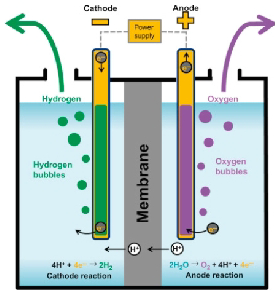
The energy intensity of the electrolysis process is considerable, requiring at least 50 kilowatt-hours of electricity to produce one kilogram of hydrogen. This implies that a facility producing 100 kilograms of hydrogen daily necessitates a power supply system of at least 230 kilowatts. As the hydrogen energy industry expands, demands on electrolysis power sources grow increasingly stringent—requiring not only stable and reliable power output but also high efficiency and intelligent capabilities.
Electrolysis Power Supply: The “Intelligent Energy Steward” Transcending Conventional Power Delivery
While standard power supplies may offer basic electrical support, specialised electrolysis power supplies function more as an “intelligent energy steward”, requiring multifaceted capabilities. Let us explore their unique value through three dimensions:
- Precision Control: The Art of Chemical Reactions
Different electrolytic applications exhibit significant variations in voltage and current requirements. Take water electrolysis and metal plating as examples: the former necessitates higher voltage and relatively lower current, while the latter may demand entirely different parameter combinations. A high-quality electrolytic power supply must enable precise regulation of both voltage and current. Insufficient voltage may prevent reactions from initiating, whereas excessive current risks damaging electrode materials. EA Elektro-Automatik's advanced power supplies, part of the Tektronix portfolio, employ digital signal processing technology to deliver millisecond-level response times, ensuring output parameters remain consistently within set limits
- Stability and Reliability: Safeguarding Continuous Operation
Once initiated, electrolytic processes demand sustained, stable operation. Power fluctuations can interrupt reactions, compromising production efficiency. Particularly in large-scale industrial production, power supply reliability directly impacts the operational efficiency of entire production lines. High-quality electrolysis power supplies employ advanced power conversion technology and multi-layered protection designs to maintain stable output under complex conditions such as grid fluctuations and load variations. Furthermore, features like the stainless steel casing used in EA power supplies from Tektronix provide excellent corrosion resistance, ensuring long-term reliable operation in harsh industrial environments.
- Safety Protection: Safeguarding Personnel and Equipment
Electrolysis processes involve high-current operations and chemical handling, making safety paramount. Modern electrolytic power supplies typically incorporate comprehensive protection features, including overcurrent protection, short-circuit protection, and overtemperature protection. These functions safeguard not only the equipment itself but, crucially, the safety of operating personnel. Particularly noteworthy is that some high-end power supply products also feature fault self-diagnosis and remote monitoring capabilities. Upon detecting anomalies, the system can automatically implement protective measures while transmitting alarm notifications to management personnel via network connections, thereby achieving genuine intelligent safety management.
How to Select the Appropriate Electrolytic Power Supply?
Selecting an electrolytic power supply is a decision-making process requiring comprehensive consideration of multiple factors. The following are three key dimensions for evaluation:
- Defining Requirements: Starting from Practical Applications
First, specific process requirements must be clearly defined. Different electrolytic processes demand vastly different power supply parameters. For instance, water electrolysis typically requires high voltages (often reaching hundreds of volts), whereas electroplating processes may prioritise current stability. It is advisable to conduct a detailed process assessment prior to selection, determining precise voltage and current ranges while allowing appropriate headroom for future process adjustments.
- Prioritise Efficiency: Consideration of Full Lifecycle Costs
Power supply efficiency directly impacts operational expenditure. High-efficiency units not only reduce electricity bills but also minimise thermal dissipation requirements, thereby lowering cooling system investments. Taking EA's bidirectional power supply as an example, its efficiency reaches 96%, yielding substantial operational savings compared to conventional units. When evaluating efficiency, focus on performance under typical load conditions rather than merely peak efficiency figures.
- Scalability: Future-proofing Investments
As business expands, capacity may need to be increased. Selecting power systems that support modular expansion avoids redundant investment. For instance, EA's power cabinets enable multiple units to operate in parallel, allowing power to scale seamlessly from tens of kilowatts to several megawatts, providing robust support for sustainable enterprise growth.
EA Power Supply's Technological Breakthroughs
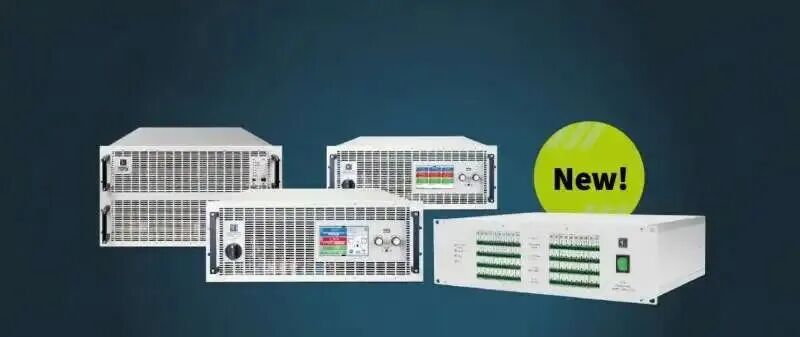
EA Elektro-Automatik, a brand under Tektronix, has introduced multiple innovative solutions in the field of electrolytic power supplies. These technological breakthroughs have opened new possibilities for the industry's development.
- The Significant Advantages of Modular Design
Traditional power systems often necessitate complete equipment replacement when expansion is required. In contrast, the modular design of EA, a brand under Tektronix, enables a flexible “scale-as-you-grow” approach. A single standard cabinet can accommodate multiple power modules, enabling flexible power configuration through intelligent parallel technology. The benefits of this design are evident: initial investment can be tailored to actual requirements, with subsequent expansion achieved simply by adding modules, significantly enhancing capital efficiency. Furthermore, the modular design simplifies maintenance; should an individual module fail, it can be directly replaced, minimising downtime.
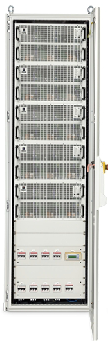
Illustration: A single 42U power cabinet can integrate five 6U power modules, delivering up to 300kW of power and significantly saving space in production workshops.
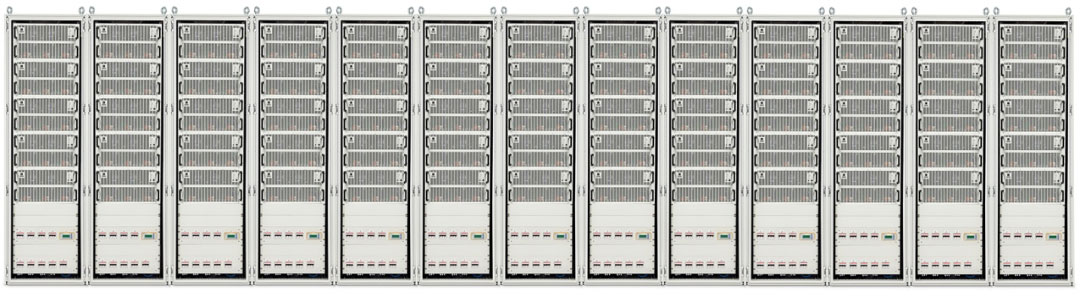
As illustrated, adding a further 12 cabinets can be combined to produce a total output power of up to 3.84 MW.
- Share-Bus™ Technology: Intelligent Power Distribution
EA's proprietary Share-Bus™ technology represents a core innovation for power supply parallel operation. This technology achieves load balancing between power modules via an intelligent bus system, ensuring each module operates under optimal conditions. The value of this technology is particularly evident in large-scale electrolysis projects. When the system requires output power adjustment, the control unit intelligently distributes the load across modules, preventing individual units from operating under excessive load. Simultaneously, should a module fail, the system automatically isolates it while the remaining modules continue normal operation, guaranteeing continuity in the production process.
- Automatic Range Output: Wider Operating Range
Unlike the square-wave output characteristic of conventional power supplies, Tektronix's EA power supply employs a true automatic range design. This enables the power supply to deliver full power output across an extensive voltage range without switching operating modes.
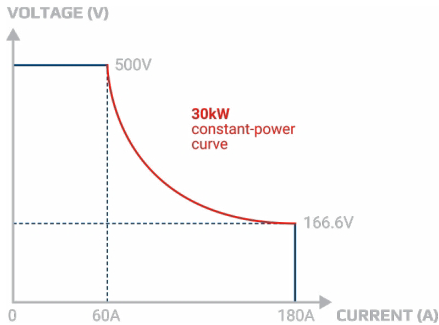
Diagram. Output characteristics of the EA automatic range power supply rated at 500V maximum voltage and 30kW power. Note that this power supply delivers full power output across the entire voltage range from 500V to 166.6V.
This feature holds significant practical importance. For instance, during different stages of the electrolysis process, load characteristics may undergo changes. The automatic range function can adapt to these variations automatically, ensuring optimal performance is consistently delivered. This not only enhances equipment utilisation but also streamlines operational procedures.
Supports comprehensive application scenarios from laboratory to industrial production
Selecting an electrolytic power supply is a decision-making process requiring comprehensive consideration of multiple factors. The following are three key dimensions for evaluation:
-
Application of small-scale experimental units. The precise power control capability enables R&D personnel to obtain reproducible experimental data, thereby accelerating development progress.
- Medium-scale demonstration projects. Modular design allows project operators to implement phased deployment according to production line schedules, reducing initial capital pressure.
-
Large-scale industrial installations. The system's reliability and scalability meet the continuous production requirements of major green hydrogen projects, while intelligent monitoring systems will also help reduce operational maintenance workloads.
Future Development Trends and Outlook
With the acceleration of the global energy transition, the electrolytic power supply market will maintain rapid growth. Particularly in regions abundant in renewable energy, electrolytic hydrogen production projects will be deployed on a large scale, driving sustained demand for high-performance power supplies.
Beyond traditional industrial applications, electrolytic power supplies hold promising prospects in emerging fields:
-
Direct coupling with renewable energy generation
-
Mobile hydrogen production units
-
Distributed energy systems
-
Energy internet nodes
Electrolytic DC power supplies, as critical equipment within the hydrogen energy industry chain, are of paramount importance. Selecting the appropriate power solution not only impacts the economic viability of current projects but also shapes a company's competitive standing in the hydrogen era.
EA Elektro-Automatik, a brand under Tektronix, has become the preferred partner for numerous global hydrogen projects through its advanced technology, reliable products, and extensive experience. From laboratory development to industrial production, and from stationary installations to mobile applications, EA delivers bespoke solutions.

 English