2) Power Supply Rejection Rate and Supply Voltage Rejection Ratio (SVRR)
These two parameters reflect the adaptability of the amplifier to the power supply. Their unit is decibel (dB), but the focus is different. The larger the absolute value, the better. PSRR mainly reflects the ability to suppress power supply noise at 50Hz and 100Hz, and amplifiers using industrial frequency power supplies should be given priority.
SVRR mainly reflects the ability to suppress high-frequency power supply noise, and amplifiers using switching power supplies should be given priority.
3) Signal-to-Noise Ratio (SNR) and Common Mode Noise Rejection Ratio (CMRR)
These two parameters reflect the adaptability of the amplifier to noise, and their unit is decibel (dB). SNR mainly reflects the ability to suppress line loop noise, and can also be expressed by S/N. CMRR mainly reflects the ability to suppress radio frequency and wireless crosstalk signals. The larger the absolute value, the better.
4) Efficiency
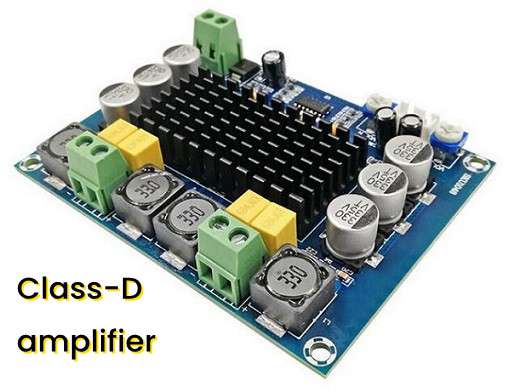
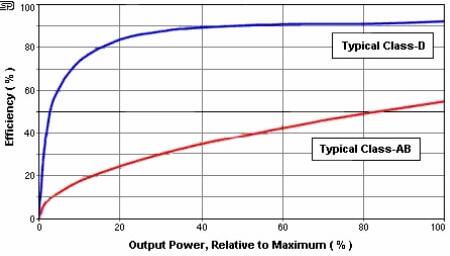
The power consumption efficiency of a class D amplifier is expressed as a percentage, theoretically the higher the better, but it is best to compare the THD+N and EMI indicators at the same time. The ideal efficiency of a class D amplifier can reach 100%, and now it has reached about 90% in practice.
5) Frequency Response
It is used to indicate the consistency of the amplification factor of the power amplifier to different frequency signals within the specified range. An ideal power amplifier has the same amplification factor for all frequency signals, and the frequency response curve is a horizontal straight line. If the curve is uneven, humming will occur.
6) Damping Coefficient
It is the ratio of the load impedance to the internal resistance of the power amplifier. It characterizes the ability of the power amplifier to control the speaker. Usually the internal resistance of amplifier is small enough, and it is generally believed that the damping coefficient greater than 200 is good enough. In actual engineering, the connection between the speaker and the power amplifier is the main reason for the bad control ability to the speaker.
It should be noted that due to the consideration of power, impedance, distortion, dynamics, different use ranges and control adjustment functions, different power amplifiers are different in internal signal processing, circuit design and production technology.
Output Signal Analysis
The output switching state of the power amplifier, that is, the output is a square wave, which is known by Fourier series analysis:

After the high-order harmonics are filtered by the low-pass filter, the maximum value of the output signal is, so the maximum power that the load can obtain is 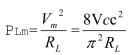 .
The average current of the circuit is 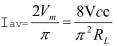 , the input power of the power supply is
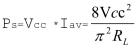 . It can be seen from the ratio of PLM and Ps that the theoretical efficiency of Class D amplifier reaches 100%.
In addition, the Class D amplifier mainly provides 20~20KHz audio amplification, so the pulse width modulation must use a frequency greater than 10 times, the higher the frequency, the more delicate and clear the restored signal will be.
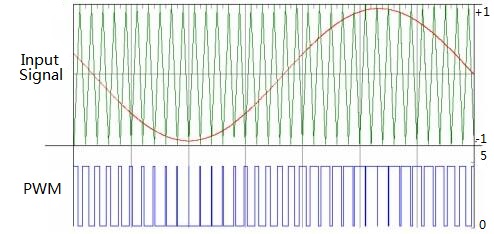
Figure 3: PWM Output Waveform
Class D amplifiers start by generating a series of fixed-amplitude rectangular pulses that vary in area and interval, or per unit time. Furthermore, amplitude changes in the analog audio input stream are also represented by these pulses, and it is also possible to synchronize the modulator clock to the incoming digital audio input signal, thus eliminating the need to convert the digital audio signal to analog. The output stage of the modulator controls the operation of the output transistors by alternately turning them on and off. It's important to make sure that the pair of transistors don't turn on at the same time. If it conducts together, a short circuit occurs between the power rails through the transistor.
Since transistors are either 'on' or 'off', they spend a short time in the linear region, and during this time they consume very little power, which is a major factor in their high efficiency.
In additional, a basic low-pass filter consisting of an inductor and capacitor guides the low-frequency path for the audio signal while leaving high-frequency pulses behind. Sometimes output stage filters are omitted for cost reduction reasons. However, with the development of technology, most of the newer class D power amplifiers have converted to a filterless structure. They rely on the inductance and impedance of the external speaker to form a low-pass filter. However, without speaker connection, the high frequency switching signals are not well filtered.
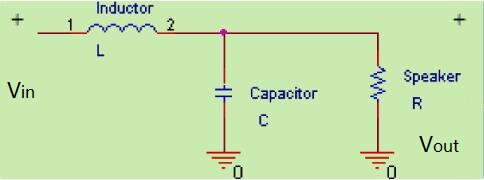
Figure 4: LC Low-pass Filter Circuit
The restoration of the PWM signal output by the Class D amplifier to the original audio signal requires an LC low-pass filter (not on-board), and the distortion and efficiency are rely on the performance of the low-pass filter. Therefore, the ideal low-pass filter should be a passive LC filter structure, but the inductance value is often special and quite large, which is not easy to get. If less demanding, a simple but slightly lower performance passive RC low-pass filter can also be used instead.
Advantages and Disadvantages
* Advantages
High efficiency, wide application, high sound quality, low energy consumption, small size.
* Disadvantages
The biggest disadvantage of class D power amplifier is that there is no specific switch, if the power transistors and other components are not properly matched, the quality of the whole product will be greatly reduced.
Class D Amplifier Application Example
* Why do home stereo systems choose Class D amplifiers?
When looking for the best audio amplifier for your home stereo system, you'll find that most amplifiers are made from Class D amplifiers. It is almost universally used in home stereo systems. Because of its simple design, stable performance, and much smaller size compared to other amplifiers. Another reason is that it works best with wireless surround speakers or a Bluetooth surround system. If you don't want to hear any sonic distortion such as clicking, popping or hissing from your audio system, then choosing a class D amplifier will be a good choice. Class D amplifiers sound more clearer and are known for their high efficiency.
Modern Class D amplifiers are designed with wireless systems so anyone can transmit their favorite music wirelessly via Bluetooth, WIFI and Airplay, but also wirelessly control the connection of the whole house audio through the amplifier. Modern class D amplifiers improve the performance of speakers and subwoofers, making speakers play loud and clear, and ensuring sound quality for recordings. Considering all facts and comparison with other amplifiers, Class D amplifier is best for home stereo system.
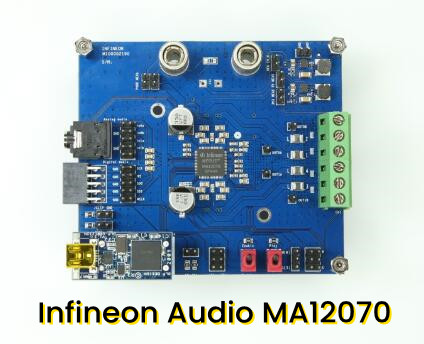
MA12070 - Typical Class D Audio Amplifier Module
MA12070 is a filterless and super-efficient audio power amplifier, based on multi-level switching technology.It uses two power half-bridges with 4 MOSFETs where each transistor is driven by its own separate PWM signal, allowing it to be used in many different applications.
MA12070 Datasheet
|
Amplification technology
|
Class D
|
|
Channels
|
2.0
|
|
Power @26V PVDD, RL = 4Ω, THD+N = 10%
|
2 x 80W
|
|
Idle consumption
|
≤160mW
|
|
SNR
|
≥110dB
|
|
Noise (A-weighted)
|
7. 45µV
|
|
Dimensions
|
60 x 80 x 33 mm
|
|
Spacer
|
50 x 70 mm
|
|
Power Supply
|
24 - 26VDC
|
|
Completely lead free
|
yes
|
|
Halogen free
|
yes
|
|
RoHS compliant
|
yes
|
|
Packing Type
|
TAPE & REEL
|
|
Moisture Level
|
3
|
|
Moisture Packing
|
DRY
|
Features
1. Proprietary Multi-level Switching Technology
1) 3-level and 5-level modulation
* Low EMI emission
* Filterless amplification
2) Digital Power Management Algorithm
2. High Power Efficiency (PMP4)
1) >80% Efficiency at 1W power (1kHz sine, 8Ω)
2) >91% Efficiency at Full Power (1kHz sine, 8Ω)
3. Audio Performance (PMP2)
1) >110dB DNR (A-w, rel. to 1% THD+N power level)
2) 45µV output integrated noise (A-w)
3) 0.004% THD+N at high output levels
4. 4th Order Feedback Error Control
1) High suppression of supply disturbance
2) HD audio quality
5. Supply Voltages: +4V to +26V (PVDD) and +5V (A/DVDD)
6. Selectable Gain (20dB/26dB)
7. 2x30W continuous output power (RL = 8Ω at 22V, PMP4, 10% THD+N level, without heatsink)
8. 2×80W peak output power (26V PVDD, RL = 4Ω, 10% THD+N level)
9. 2.0, 2.1, 4.0, 1.0 Output Stage Configurations
10. Protection
1) Under-voltage-lockout
2) Over-temperature warning/error
3) Short-circuit/overload protection
4) Power stage pin-to-pin short-circuit
5) Error-reporting through a serial interface (I2C)
6) DC protection
11. I2C control (four selectable addresses)
12. Heatsink free operation with EPAD-down package
MA12070 Advantages
1) Unparalleled power efficiency - optimized for music playback with very low power losses and cool operation
2) Ultra compact, fully integrated solution – high power output in a small form factor
3) HD audio quality & best in class audio performance - high dynamic range, low distortion, low noise
4) Low interference / EMI emission - EMC compliance without use of large filter component
5) High suppression of supply ripples
6) Reduced BoM and associated system cost savings
7) Reduction of battery sizes through better power efficiency
8) Eliminates complex dynamic rail tracking
9) Offers filter-less amplification and eliminates LC filters in many applications
10) Heatsink free operation with EPAD-down package
11) Flexible solution – highly configurable for tailored performance in individual applications
Applications
1) Portable audio - battery operated speakers, on-the-go bluetooth speakers, docking speakers, boom boxes, wearable speakers
2) Home audio – multi-room systems, television, soundbars, home theater systems, stand-alone components
3) Voice controlled audio
4) Pro audio - active monitor speakers, power-over-ethernet (PoE), multi-channel systems
Most Popular Manufacturer of Class-D Amplifier
* Texas Instruments
* Maxim Integrated
* STMicroelectronics
* Skyworks
* Infineon Technologies
* Analog Devices
* Renesas Electronics
* ROHM Semiconductors

 English