Semiconductor cooling technology is realized based on the thermoelectric effect of materials. That is, when the current passes through the contact point of two different semiconductor materials, the electrons in these materials transfer energy due to temperature difference. The devices based on it are characterized by small size, no noise, no pollution, no mechanical parts, fast response, high efficiency and reliability, etc.
Thermoelectric Cooler
Basic Concept
The thermoelectric cooler using semiconductor materials made according to this principle can transfer heat energy from one side to the other, so as to realize the cooling effect. It is a heat sink for semiconductor chips, which consists of a metal substrate and thermally conductive materials. The advantages of it are small size, light weight, high efficiency, and low cost.
It is also called a heat pump. Its advantage is that it has no sliding parts. And it is used in some places where the space is limited, the reliability is high, and there is no refrigerant pollution.
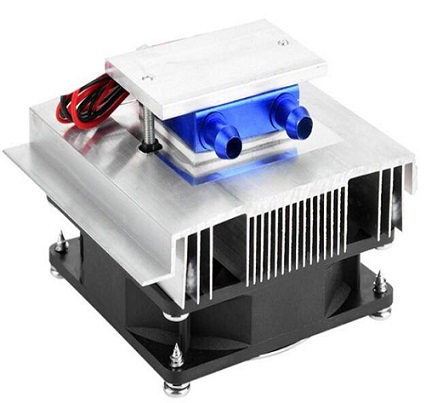
The working and operation of it uses direct current, which can both cool and heat. By changing the polarity of DC, it is decided to realize cooling or heating on the same refrigerating sheet. For example, a single cooling chip, which is composed of two ceramic chips, with N-type and P-type semiconductor materials in the middle. And it is connected in series on the circuit.
The working principle of it is: when a piece of N-type semiconductor material and a piece of P-type semiconductor material are connected to form a galvanic pair, after a DC current is connected in this circuit, energy transfer can occur, and the current flows from the N-type element to the joint of the P-type element absorbs heat and becomes the cold end. The heat is released from the joint of the P-type element to the N-type element and becomes the hot end. The size of heat absorption and heat release is determined by the size of the current and the number of pairs of semiconductor materials N and P. Inside the cooling sheet is a thermopile composed of hundreds of pairs of electric couples to achieve enhanced cooling effects.
Three Effects
The following three points are belonging to the thermoelectric effect.
1) Seebeck Effect
In 1822, the German Seebeck discovered that when two different conductors are connected, if the two connection points maintain different temperature differences, a thermoelectric force will be generated in the conductor: ES=S.△T
Where,
ES is the thermoelectromotive force.
S is the thermoelectric potential rate (Seebeck coefficient).
ΔT is the temperature difference between the junctions.
2) Peltier Effect
In 1834, the Frenchman Peltier discovered the effect of the Seebeck effect, that is, when the current flows through the joint formed by two different conductors, heat release and heat absorption will occur at the joint, and the heat release or heat absorption is determined by the current.
Formula: Qл=л.Iл=aTc
Where,
Qπ is the exothermic or endothermic power.
π is a proportionality coefficient, called the Peltier coefficient.
I is the working current.
a is thermoelectric potential rate.
Tc is the cold junction temperature.
3) Thomson Effect
When the current flows through a conductor with a temperature gradient, in addition to the Joule heat generated by the resistance of the conductor, the conductor also releases or absorbs heat. Between two points of the conductor with a temperature difference of △T, the heat released or absorbed is :
Formula: Qτ=τ.I.△T
Where,
Qτ is the exothermic or endothermic power.
τ is the Thomson coefficient.
I is the working current.
ΔT is the temperature gradient.
According to research findings, bismuth telluride compound solid solution has a good cooling effect, which is the earliest and most important thermoelectric semiconductor material, and is still a main component in thermoelectric refrigeration.
Characteristics
As a special cold source, the thermoelectric cooler has the following characteristics in technical application:
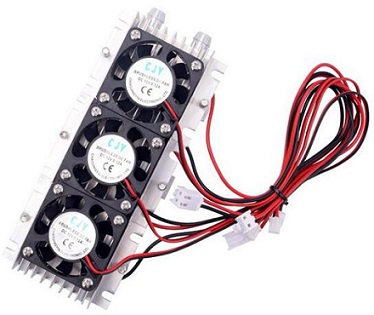
1) It does not need any refrigerant, and there is no pollution source, no rotating parts, no gyration effect, no sliding parts.
2) It is a solid piece, no vibration, noise, long life and easy installation.
3) The thermoelectric cooler has two functions, which can not only cool, but also heat. Thus, separate heating and cooling systems can be replaced with one device.
4) It is a current-transforming chip. Through the control of the input current, high-precision temperature control can be realized. Coupled with temperature detection and control means, it is easy to realize remote control, program control, and computer control, which is convenient for forming automatic control system.
5) The thermal inertia of it is very small, and the cooling and heating time is very fast. When the hot end has good heat dissipation and the cold end is empty, the cooling chip can reach the maximum temperature difference in less than one minute after being powered on.
6) The reverse use of it is temperature difference power generation, and it is generally suitable for power generation in medium and low temperature areas.
7) The power of a single cooling element pair of it is very small, but combined into a stack in series and parallel to form a cooling system, the power can be made very large.
8) The temperature difference range of it can be realized from a positive temperature of 90°C to a negative temperature of 130°C.
Pros and Cons
Advantages
1) The size of thermoelectric cooler is small, and it can be made into a refrigerator with a volume of less than 1cm³.
2) The weight is light, and the miniature refrigerator can be only a few tens of grams or even several grams.
3) There is no mechanical transmission part, no noise during work, and no liquid or gaseous work medium, so it does not pollute the environment.
4) The cooling parameters are not affected by the direction of space and gravity, and can work normally under large mechanical overload conditions.
5) By adjusting the size of the working current, the cooling rate can be easily adjusted.
6) By switching the direction of the current, it can be used from the cooling state to the heating state.
7) The service life is long, and it is easy to control.
Shortcomings
1) The temperature difference of it is small and the refrigeration coefficient is not high.
2) There are few researches on the optimal design of the cooling system at the cold and hot ends.
3) There are few references to technologies in related fields, especially the stagnation of the material figure of merit has affected the development of the entire semiconductor refrigeration industry.
4) With the rapid development of science and technology, the size of some product devices is getting larger, some are getting smaller, so various factors need to be considered. In this way, how to solve the optimization problem of high-power semiconductor multi-stage refrigeration, the problem of local heat dissipation of small-sized devices and the problem of multi-factor thermoelectric cooler energy conversion will become the content of continuous research in the future.
Applications
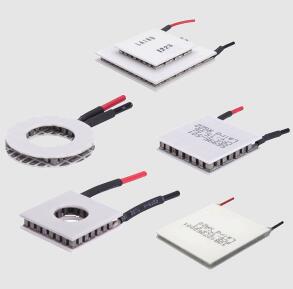
Semiconductor thermoelectric cooler technology has huge potential in many fields. One of the most important applications is the cooling of electronic equipment. With the continuous evolution and development of electronic equipment, its integration and power consumption are also increasing, so the demand for cooling is becoming more and more urgent. The thermoelectric cooling can provide high-efficiency cooling for electronic equipment and help maintain the normal operating temperature of the equipment. In addition, it can also be applied to optical devices, lasers, biomedicine, aerospace and other fields.
1) In military: infrared detection and navigation systems for missiles, radars, submarines, etc.
2) In medical treatment: cold force, cold seal, cataract extraction film, blood analyzer, etc.
3) As laboratory equipment: cold traps, cold boxes, cold tanks, electronic low temperature test devices, various constant temperature, high and low temperature test instruments.
4) As special equipment: low temperature tester for petroleum products, low temperature tester for biochemical products, bacterial incubator, constant temperature developing tank, etc.
5) In daily life: air conditioners, hot and cold boxes, water dispensers, electronic mailboxes, computers and other electrical appliances.
Environment Friendly
Compared with traditional cooling technology, semiconductor cooling technology has obvious advantages in terms of energy efficiency and environmental sustainability. First of all, it has a high efficiency conversion rate, which can convert electrical energy into cooling effect and reduce energy waste.
Second, it does not use traditional refrigerants, such as hydrofluorocarbons (CFCs) and hydrofluorocarbons (HFCs), which have negative effects on the atmospheric ozone layer and increase the greenhouse effect. On the contrary, it uses non-toxic and non-polluting materials, such as semiconductor materials such as silicon (Si) and germanium (Ge), thereby reducing the bad impact on the environment.
Q: Which is better, compressor cooling or semiconductor cooling?
Both have their strengths, and the purpose of the two is different. If it requires high-power cooler, compressor cooling is used. If it is used for low-power devices, semiconductor cooling is convenient and has low noise.
Details are as follows:
1. Advantages & Disadvantages of compressor cooling:
1) High refrigeration efficiency, the highest COP can reach 3.8, energy saving and environment friendly.
2) Difficult to start at low temperature, low heating efficiency in winter, afraid of vibration, cannot be tilted and turned upside down at will. System maintenance requires pyrotechnics to replace damaged components, and it has to let go of the refrigerant, which is a waste.
2. Advantages & Disadvantages of semiconductor cooling:
1) Semiconductor air conditioners have no refrigerant, will not leak, are not afraid of vibration, tilt, or upside down; there is no mechanical movement in operation, and they will not wear out; they are small in size and high in reliability.
2) Have low refrigeration efficiency, and the cooling performance changes nonlinearly with the influence of ambient temperature, voltage, thickness of the cooling block, heat dissipation mode of the cold end, mechanical pressure, and thermal conductivity phase change material.
In addition, semiconductor cooling technology needs more research and innovation to improve efficiency and reliability. For example, improving the characteristics and thermoelectric conversion efficiency of semiconductor materials, optimizing the design and structure of coolers, etc. This will require close cooperation between academia, industry and market to advance the development of semiconductor refrigeration technology.
Challenges and Trends
Although semiconductor thermoelectric cooling technology has many potentials and advantages, it still faces some challenges in the process of its wide application. One of them is the issue of cost. At present, the high manufacturing cost of it limits its popularization in large-scale applications. However, with the continuous advancement of technology and the expansion of production scale, it is believed that the manufacturing cost will gradually decrease, making semiconductor refrigeration technology more competitive.

 English